

AI Consulting in Finland
How to choose, scope and get real value from AI consultants in the land of Nokia, Linux and Elements of AI.
Introduction: Why Finland Is a Serious AI Market
Finland has a reputation far larger than its population of roughly 5.6 million. It produced Linux, helped build the modern mobile industry, and created some of the world's best-known games. In AI, it launched Elements of AI, a free online course from the University of Helsinki and MinnaLearn that introduced hundreds of thousands of people worldwide to the basics. It also hosts LUMI, one of Europe's most powerful supercomputers, in Kajaani, and has strong research environments at the Finnish Center for Artificial Intelligence (FCAI), Aalto University, the University of Helsinki and VTT.
Yet for most Finnish companies, the practical question is not about research. It is simpler and harder: should we hire an AI consultant, who should it be, and how do we make sure it pays off?
This guide answers those questions. It covers what AI consulting in Finland looks like, the types of firms available, what engagements cost and deliver, how local factors such as language, regulation and employee co-determination change the picture, and a checklist you can use before signing anything.
The Finnish AI Consulting Landscape
The Finnish market is compact and well connected. Rather than a long list of names, it helps to think in categories.
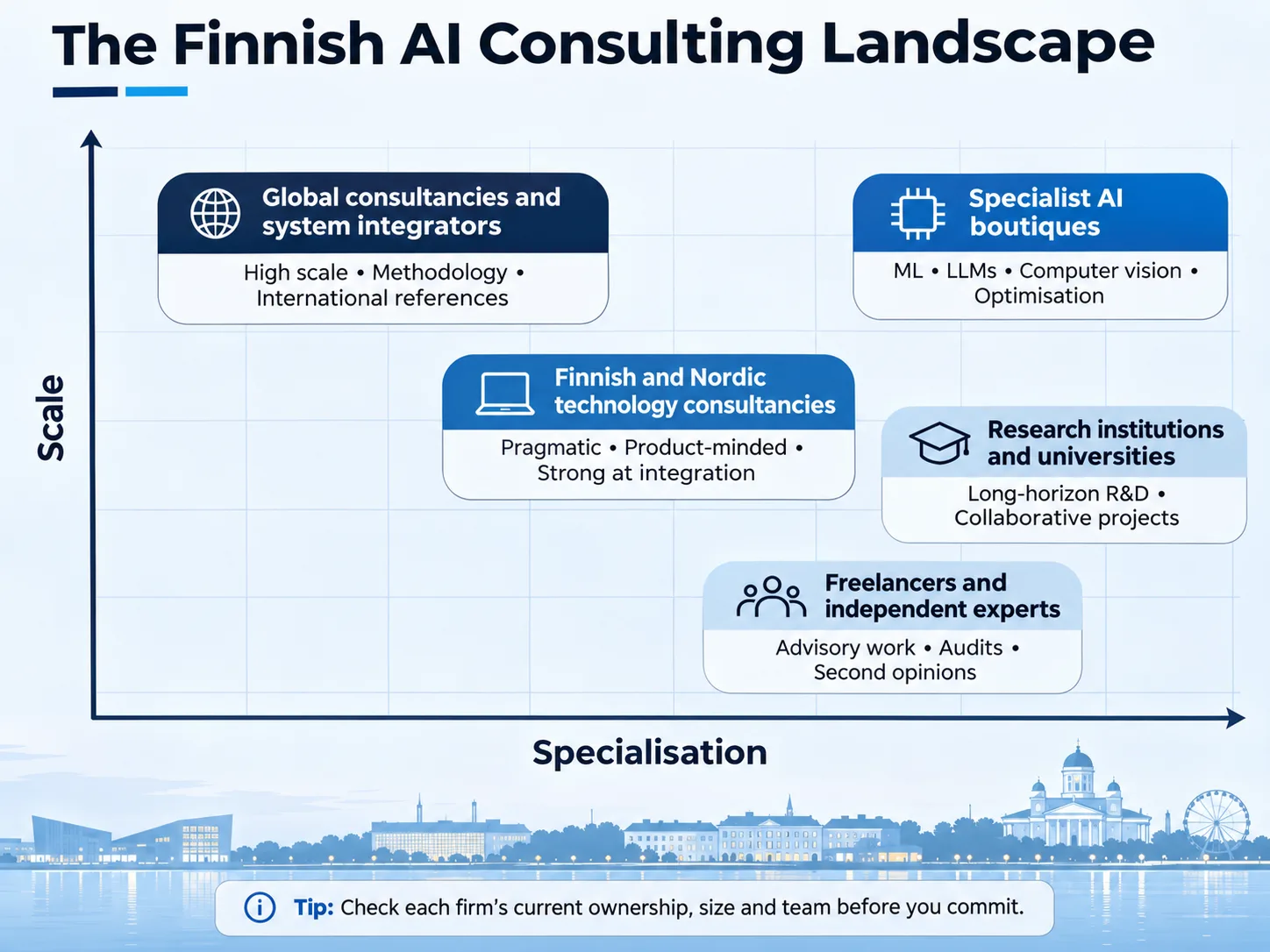
- Global consultancies and system integrators. Large firms with Finnish offices bring scale, methodology and international references. They suit big transformation programmes and regulated industries.
- Finnish and Nordic technology consultancies. Companies in the Helsinki, Tampere and Oulu tech scenes combine software engineering with data and AI. They tend to be pragmatic, product-minded and strong at integration.
- Specialist AI boutiques. Smaller teams, often founded by researchers, focus on machine learning, language models, computer vision or optimisation. Finland has been notable for these, and several have been acquired by international groups as the market matured.
- Research institutions and universities. VTT, Aalto, the University of Helsinki and others run collaborative projects, particularly for deep technical problems with a long horizon.
- Freelancers and independent experts. Useful for short advisory work, audits and second opinions.
Tip: Check any firm's current ownership, size and team before you commit. In a fast-moving market, mergers and acquisitions change what a company can offer.
Why Finnish Companies Hire AI Consultants
Buying consulting is rarely about a lack of ideas. In Finland, the common triggers are:
- A thin talent pool. Skilled data scientists and ML engineers are scarce, and competing with international employers on salary is hard for mid-sized firms.
- Pressure to prove value fast. Boards want evidence, not experiments, and consultants can compress learning time.
- Need for an outside view. An independent assessment helps cut through internal enthusiasm or scepticism.
- Regulatory uncertainty. The EU AI Act, GDPR and sector rules create demand for expert guidance.
- Legacy systems. Many Finnish industrial and public organisations run decades-old systems that make AI integration difficult.
Where AI Consulting Is Creating Value in Finland
Finland's economy is built on a specific mix of industries, and consulting demand follows it.
- Industrial and manufacturing: predictive maintenance, quality inspection and production planning for machinery, energy equipment, elevators and metals.
- Forestry and bioeconomy: forecasting, logistics and process optimisation across the wood value chain.
- Energy and utilities: demand forecasting, grid balancing and trading, helped by a grid with a high share of renewable and nuclear power.
- Telecommunications: network optimisation and customer analytics, building on the country's telecom heritage.
- Maritime and logistics: route planning, fuel efficiency and port operations.
- Healthcare and public sector: documentation, triage support and case handling. Finland's high-quality registries are an asset, though governance requirements are strict.
- Retail, banking and insurance: customer service assistants, fraud detection, pricing and personalisation.
- Games and software: analytics, content tools and development productivity.
What AI Consultants Actually Do: Types of Engagements
Not all consulting is the same. Knowing the engagement type helps you set expectations and budget.
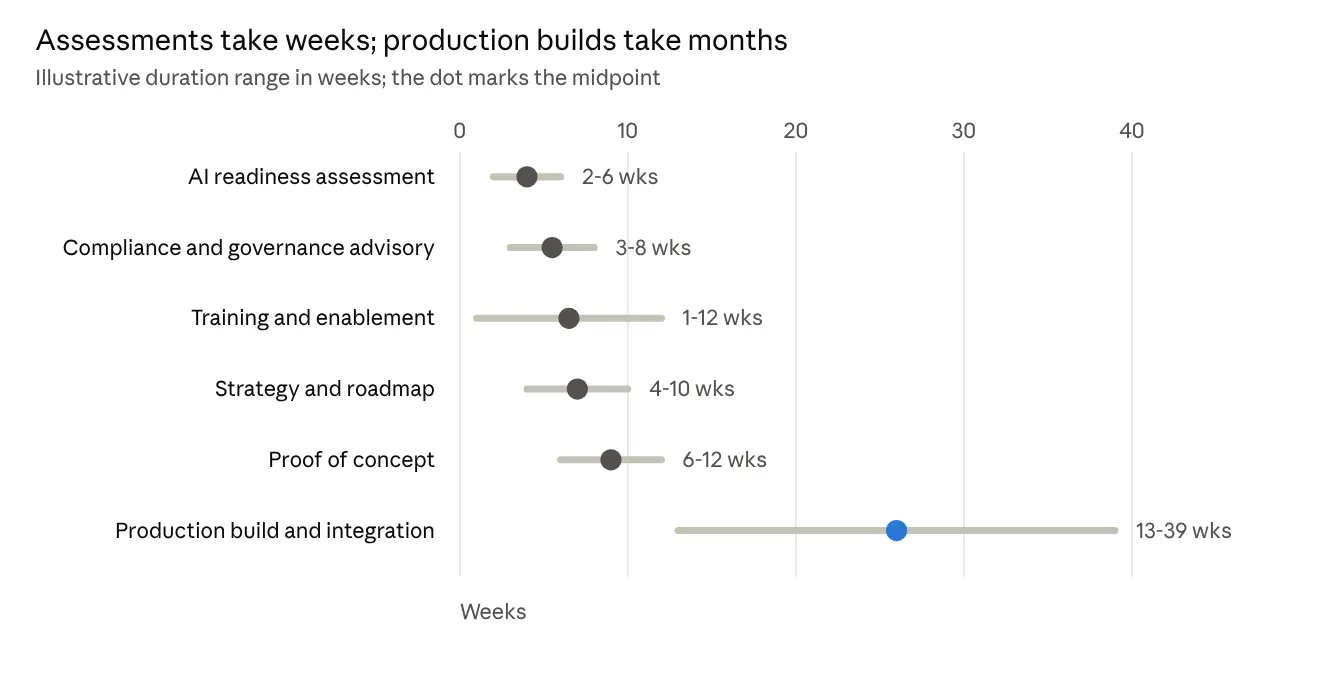
| Engagement type | What you get | Typical duration | Best for |
|---|---|---|---|
| AI readiness assessment | Review of data, systems, skills and use-case ideas | 2 to 6 weeks | Companies at the starting line |
| Strategy and roadmap | Prioritised use cases, business cases, governance plan | 4 to 10 weeks | Leadership teams needing direction |
| Proof of concept | Working prototype tested on real data | 6 to 12 weeks | Validating a specific idea |
| Production build and integration | Deployed solution connected to your systems | 3 to 9 months | Proven use cases ready to scale |
| Managed service and MLOps | Monitoring, retraining, support | Ongoing | Teams without in-house ML operations |
| Training and enablement | Workshops, upskilling, internal champions | 1 to 12 weeks | Adoption and long-term capability |
| Compliance and governance advisory | AI Act classification, risk assessment, policies | 3 to 8 weeks | Regulated or high-risk use cases |
Illustrative planning ranges, not quotes
What Does AI Consulting Cost in Finland?
Prices vary widely by firm, seniority and scope, so treat any figure as a starting point for your own enquiries. Common pricing models are:
- Time and materials. You pay for hours worked. Flexible, but you carry the risk of overruns.
- Fixed price per phase. Common for assessments and proofs of concept. Predictable, but requires a clear scope.
- Outcome-linked or shared-risk. Part of the fee depends on results. Attractive in theory, but demands crisp, measurable metrics.
- Retainer or subscription. Used for advisory support and managed services.
A useful planning principle: the consultant's fees are often a minority of total project cost. Integration, data preparation, internal staff time, licences and change management usually add up to more. When you build the business case, budget for all of it.
Funding can help. Business Finland offers innovation and development funding for qualifying companies, and regional programmes sometimes support digital projects. Ask your consultant whether they have experience preparing funding applications, and check current eligibility directly with the funder.
Where the Effort Really Goes
One of the most common surprises for first-time buyers is how little of a successful AI project is "AI" in the narrow sense. The illustrative split below reflects a typical production project.
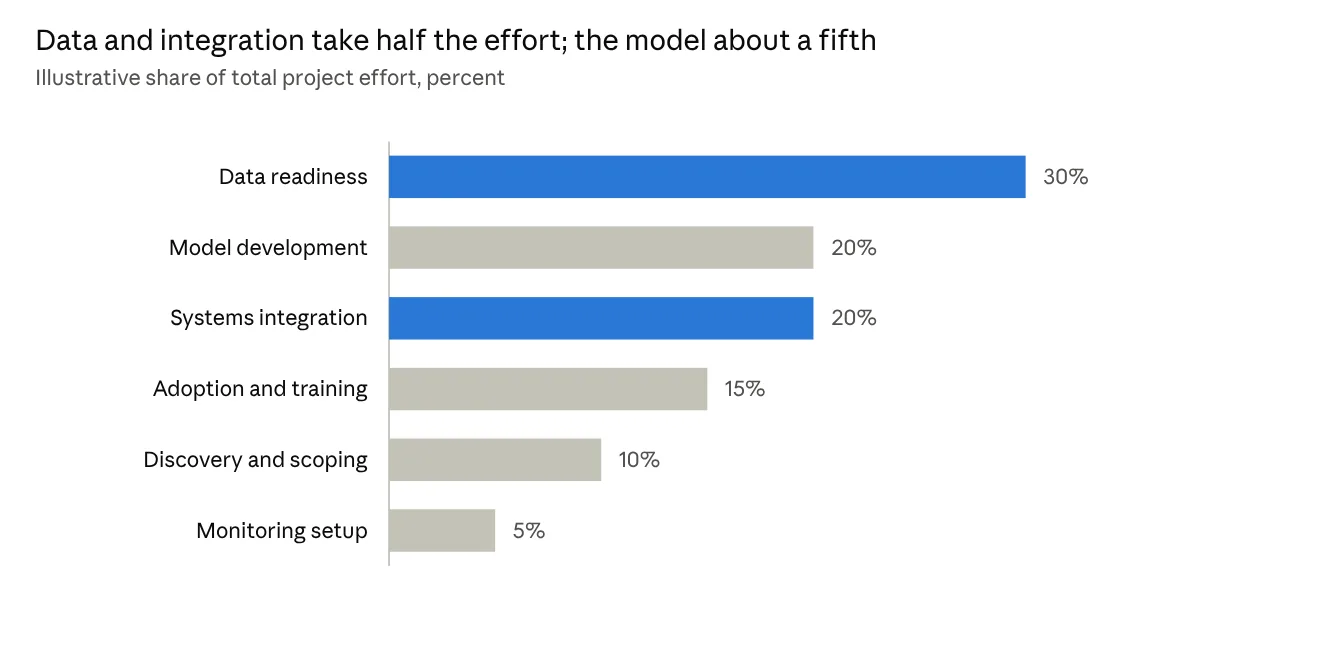
Illustrative split for a typical production project
Data readiness and integration usually take more effort than model development. A consultant who spends the first meeting talking about your data, systems and users, rather than about the latest model, is usually a good sign.
Finnish Factors That Shape AI Projects
Language
Finnish is a small, morphologically rich language, and general-purpose models often perform better in English than in Finnish. Always test candidate solutions on your own Finnish documents, customer messages or transcripts. Ask consultants how they handle Finnish and Swedish, which are both national languages, and whether they have experience with Finnish-capable models or fine-tuning. Finland has seen dedicated work on Nordic language models, so this is an area where local expertise genuinely matters.
Regulation and Compliance
The EU AI Act applies in Finland, alongside GDPR. Systems used in areas such as recruitment, credit scoring, education or critical infrastructure may be classified as high-risk, which brings obligations for documentation, human oversight and testing. Your consultant should be able to classify your use cases early, not after the build. Finnish authorities responsible for data protection and market surveillance also publish guidance, so check the latest from the official sources.
Employee Co-Determination
Finland has a strong tradition of employee involvement. Under the Finnish co-operation legislation, employers of a certain size must consult employees or their representatives about changes that affect work, such as new technology that changes tasks or staffing. Involving staff early is not only a legal consideration, it improves adoption. Ask any consultant how they involve employees, and confirm legal obligations with your own counsel.
Data Sovereignty and Hosting
Many Finnish organisations, particularly in the public sector, healthcare, defence-related industries and finance, prefer EU-based hosting and strict control over where data flows. Finland's cool climate and low-carbon electricity also make it attractive for data centres. Make hosting, model location and vendor access part of your requirements from day one.
Culture and Working Style
Finnish business culture values directness, reliability and doing what you said you would do. That is an advantage when working with consultants: expect straight talk about what is feasible, and expect to give the same in return. Over-promising tends to be punished.
Questions to Ask in the First Meeting
- What business metric will this project move, and how will we measure it?
- What data do you need, and what if our data is not ready?
- Who will be on the team, and what is their experience?
- What does production look like, and who runs it after launch?
- How do you handle Finnish-language content?
- How will you address the AI Act and GDPR?
- What happens if the proof of concept fails? What do we keep?
- Who owns the code, models and documentation?
- Can we speak to two clients with similar projects?
- How will you transfer knowledge to our team?
How to Know If Consulting Paid Off
Before you start, record a baseline. Afterwards, track outcomes rather than activity.
- Efficiency: hours saved, cycle time, cost per case
- Quality: error rate, rework, customer satisfaction
- Revenue: conversion, retention, new offerings
- Risk: compliance incidents, fraud losses, safety events
- Adoption: share of target users active weekly
- Capability: number of internal staff able to maintain and extend the solution
Review quarterly. If a use case is not meeting its target after a fair trial, stop it and redirect the budget.
Key Takeaways
- Finland offers a strong, well-connected AI ecosystem, from global firms to research institutions and specialist boutiques.
- Match the engagement type to your maturity: assessment, proof of concept, production or managed service.
- Consulting fees are often a minority of total cost, so budget for data, integration and adoption.
- Test Finnish-language performance on your own content before committing.
- Classify AI Act risk early and involve employees early.
- Choose consultants who challenge your idea, show production experience and plan for knowledge transfer.
- Measure outcomes against a baseline and be willing to stop what does not work.
Conclusion
Finland is a place where AI can work well: skilled people, trusted institutions, strong industry and a culture that values plain speaking. A good AI consultant helps you use those strengths faster and avoid expensive detours. A poor one leaves you with a slide deck and a prototype that never ships.
Start small, with one problem, one metric and one owner. Choose a partner who is honest about what AI can and cannot do. And make sure that when the engagement ends, your own organisation knows more, and can do more, than when it began.