

AI Strategy for Nordic Businesses: How to Turn AI Investment Into Competitive Advantage
Nordic businesses do not have an AI adoption problem. They have an AI value problem.
The numbers tell the story clearly. In 2025, 42% of Danish enterprises used AI, more than double the EU average of 20% (Eurostat). In Deloitte's 2026 Nordic survey, 79% of organizations said AI has improved their efficiency. Yet according to BCG's 2026 Nordic research, only 4% of Nordic companies report returns of at least five times their AI investment.
So Nordic companies are using AI. Employees have access to tools. Infrastructure is ready, and investment is rising. But relatively few organizations are turning all this activity into exceptional business results.
This raises the central question for every Nordic leader today: what separates AI adoption from AI value creation?
In this article, we'll cover:
- Where Nordic AI adoption stands today
- Why high adoption isn't turning into high value yet
- Who should own AI, and how to build a balanced AI portfolio
- Why your data, your people and your governance matter
- How to approach AI agents safely
- How to measure AI value, with a practical roadmap
Where the Nordics Stand: AI Adoption Is Already High
The Nordics are not behind in AI. Three Nordic countries lead the EU in business AI use, according to Eurostat's 2025 data.
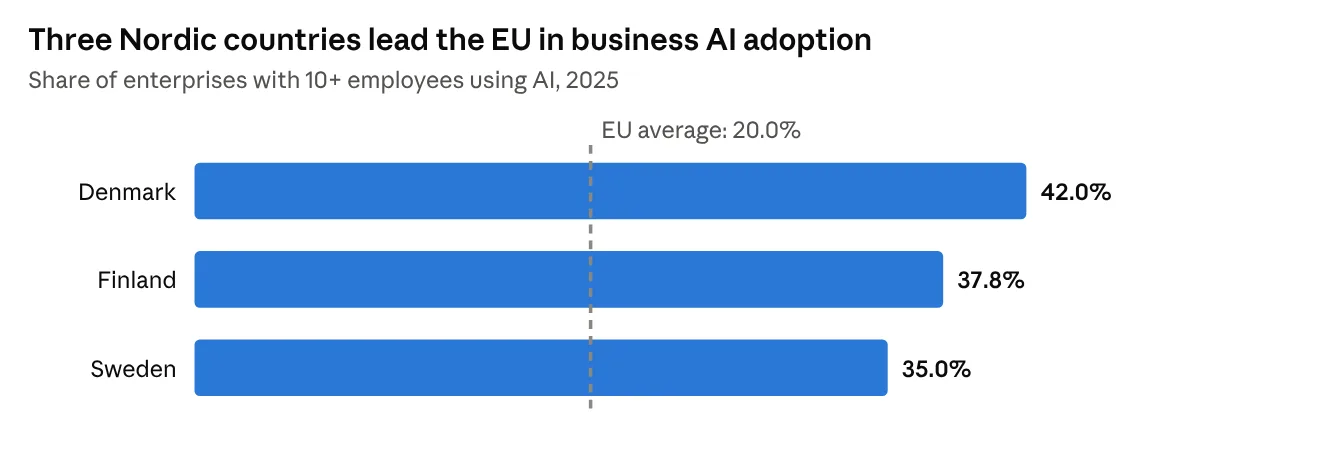
Source: Eurostat, 20% of EU enterprises use AI technologies (11 Dec 2025)
Denmark (+14.5 points) and Finland (+13.5 points) also recorded the two largest year-on-year increases in the EU.
AI is also moving from experiments into daily work. Tieto's 2026 Nordic AI Survey of 600+ IT decision-makers in Finland, Sweden and Norway found that organisation-wide AI use in production rose from 7% to 31% in one year. No respondents reported zero AI use.
Each Nordic country is also building its own national foundation:
- Sweden published its first full national AI strategy in February 2026, with the goal of becoming one of the world's top ten AI nations.
- Finland stresses world-class AI infrastructure (such as the LUMI supercomputer), closer cooperation between research and industry, and a human-centred, responsible approach to AI.
- Norway emphasises trustworthy AI, privacy, cybersecurity and data sharing, and is bringing the EU AI Act into Norwegian law in 2026.
- Iceland's AI Action Plan 2025–2027 focuses on a clear legal framework, public trust and responsible innovation.
The foundation is strong. The real question is what businesses do with it.
The AI Value Gap: Why Adoption Isn't Paying Off Yet
High adoption has not yet produced high value. Efficiency gains are common, but revenue impact is rare.
Deloitte's State of AI in the Nordics 2026, which surveyed 170 senior executives, shows the gap clearly:
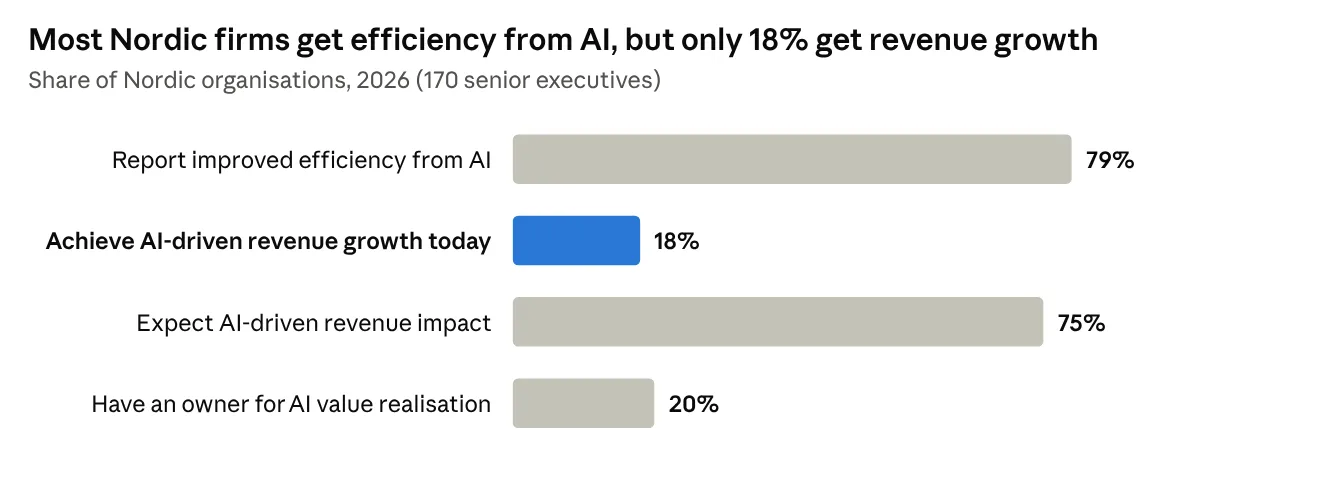
Source: Deloitte, State of AI in the Nordics 2026 (8 Apr 2026)
The gap between what organisations expect and what they achieve today is large, and few have named anyone to close it.
BCG's research points in the same direction. Nordic executives expect AI to deliver around 30% revenue growth and 25% cost reduction by 2029. Yet only 4% currently see returns of five times their investment or more. This does not mean the other 96% get no value. It means very few are getting exceptional value.
Why the gap exists
The research highlights three main reasons.
1. Investment goes mostly to generic tools. BCG found that Nordic companies spend about 40–50% of their AI budget on off-the-shelf productivity tools. Global and EU competitors spend only about 8–11% on these tools. Generic tools help individuals work faster, but they rarely create a competitive advantage.
2. Readiness is uneven. Deloitte found that 55% of Nordic organisations feel highly prepared on AI infrastructure. But only 43% feel strategically prepared, and only 14% feel prepared on talent. The technology is ready faster than the organisation.
3. AI stays in pockets. Tieto found that AI is strongest in IT operations (46%), customer service (35%) and software development (35%). But only 4% say AI is a critical part of their core business operations.
In short, the first wave of AI has made work more efficient. The harder challenge is turning that efficiency into growth and differentiation.
💡 Why This Matters
Efficiency gains are a good start, but competitors can copy them easily. Lasting advantage comes from using AI to grow revenue, serve customers better and change how the business works.
From AI Tools to AI Strategy: Who Should Own AI?

Buying AI tools is not an AI strategy. A real strategy connects AI to the outcomes the business wants to achieve.
A mature AI strategy follows a clear chain:
Business strategy → AI ambition → prioritised use cases → data and technology → people and skills → governance → measurable value → scaled deployment
Business must own AI, not only IT
In many Nordic companies, AI is still treated mainly as an IT topic. Deloitte's Nordic AI investment research (266 Nordic executives among 1,742 in Europe) shows how this compares with European peers:
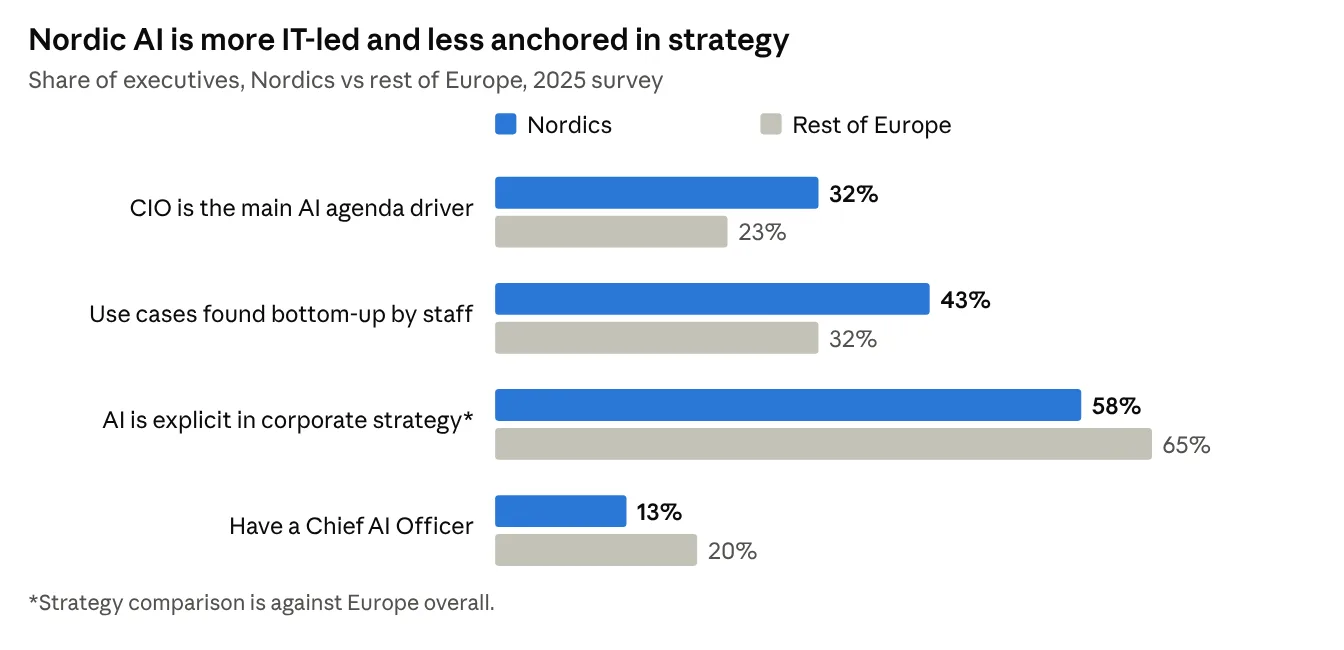
Source: Deloitte, Nordic AI investment is rising – but firms risk missing out on business value (3 Dec 2025)
Bottom-up ideas are valuable, but they often lead to many small, disconnected projects. When AI is owned by IT alone, it tends to focus on technology rather than business change.
The better model is business ownership with technology partnership. IT should enable, secure and integrate AI. Business leaders should own the value and the results.
💡 Key Idea
AI should not be another IT project. It should be a business transformation capability enabled by IT.
Start with the business you want to become
Deloitte recommends building a picture of what the company should look like with AI embedded across its functions over the next 3–5 years. That picture then guides which use cases to pursue.
In simple terms: start with the business you want to become, not the AI tools you want to buy.
How to Build a Balanced AI Portfolio
A strong AI strategy invests across three levels, not only in efficiency.
Today, Nordic AI is mostly about saving time and cost. Tieto found that efficiency is the main reason for adopting AI for 65% of organisations. Deloitte found that only 33% of successful Nordic AI initiatives target revenue, compared with 47% across Europe. Efficiency matters, but it should not be the whole strategy.
| Level | Goal | Example use cases |
|---|---|---|
| Efficiency | Do current work faster and cheaper | Document processing, customer support, coding assistance, knowledge search, reporting |
| Transformation | Redesign how core processes work | Forecasting, pricing, supply-chain optimisation, fraud detection, predictive maintenance |
| Growth | Create new value and revenue | Personalised products, AI-powered services, new customer experiences, new business models |
How to prioritise
Not every idea deserves the same funding. Score each use case on five factors:
Business impact × feasibility × data readiness × risk × time-to-value
The weighting depends on your organisation. The goal is a portfolio with a mix of quick wins, larger transformation projects, and a few longer-term experiments.
This also helps with a common barrier. 34% of Nordic respondents in Deloitte's research said a lack of viable use cases holds them back. A clear business ambition and a scoring method make good use cases easier to find.
Why Your Data Matters More Than Your AI Model

AI models are becoming easier for everyone to access. What competitors cannot easily copy is your data, your business context and your customer relationships.
So the key strategic question is not only "Which AI model should we use?" It is: "What proprietary data, context and workflows can give us an advantage that others cannot copy?"
Spotify: proprietary data over model ownership
At its 2026 Investor Day, Spotify said its AI advantage does not come from building its own general-purpose model. Instead, it applies general AI capabilities to its own user data and context. The company described a Large Taste Model that, according to Spotify, is fuelled by 3.4 trillion daily taste signals.
💡 The Lesson for Your Business
Your advantage often lies in what you know about your customers and operations, not in the AI model itself.
Klarna: AI across the business
Klarna's 2025 annual report shows AI used across many parts of the business. According to Klarna's own reported figures:
- Its AI assistant handled 80% of customer-service chats in 2025, with no drop in consumer satisfaction levels.
- That amounted to about 31 million conversations in 2025.
- Klarna has estimated that the assistant does the work of about 700 full-time agents, based on the drop in chats and calls handled by staff.
- Klarna reported $39 million in 2024 cost savings linked to the assistant.
Klarna also uses AI for personalised shopping feeds and machine learning for real-time credit decisions. The lesson is not "Klarna has a chatbot." It is that AI is built into customer service, shopping, underwriting and operations together. Klarna also shows the limits of a cost-only focus: in 2025 it said it was hiring human service staff again so customers can always reach a person (Customer Experience Dive).
What strong data foundations need
- Good data quality and easy access
- Clear permissions and privacy controls
- Known data lineage (where data comes from)
- Integration with operational systems
- Real-time business context where it matters
These foundations also address a real barrier: 24% of organisations in Tieto's survey named data quality or access as a main obstacle.
People First: Redesigning How Work Gets Done

Giving employees AI tools is not enough. The biggest gains come when companies redesign how work is done.
Deloitte found that the share of organisations where 40% or more of employees have approved AI tools rose from 37% to 56% in one year. But only 16% report extensive redesign of work to support new ways of working.
This matters because:
- AI added to an old workflow usually creates small productivity gains.
- AI combined with a redesigned workflow can create transformational value.
Skills are also a clear bottleneck. Only 14% of Nordic organisations feel highly prepared on talent (Deloitte), and 39% name skills gaps as a main barrier (Tieto). EY found that 61% of Nordic companies already provide AI training, which is a good start.
A practical workforce plan should include:
- AI literacy for all employees
- Role-specific training
- Managers who understand what AI can and cannot do
- Redesigned processes, not just new tools
- Clear points for human oversight
- Continuous learning as tools change
AI literacy is also now a legal topic. Under the EU AI Act, providers and deployers of AI have a formal obligation to ensure AI literacy among their staff.
Governance, Trust and the EU AI Act

Good governance is not a brake on AI. It is what allows AI to scale safely.
Security and trust are top concerns in the Nordics. Deloitte found that 84% of organisations see data privacy and security as a key concern, and 67% are prioritising investment in security and compliance. In Tieto's survey, cybersecurity was the biggest barrier to AI adoption, named by 45%.
The accountability gap
EY's research reveals a gap between confidence and reality. 74% of Nordic CxOs believe their AI controls are moderate or strong. But when measured against EY's nine responsible-AI principles, organisations are strong in only 3 of 9 areas on average. In addition, 53% of Nordic companies find it hard to assign accountability for emerging AI technologies, and only 26% of Nordic CEOs are actively involved in shaping emerging-technology strategy.
Every AI system needs clear answers to simple questions:
- Who owns the model?
- Who owns the data?
- Who owns the decision?
- Who is accountable if the AI output causes a business or compliance problem?
The EU AI Act is now in effect
The EU AI Act is a risk-based framework for organisations that build or use AI. According to the European Commission, its main framework became applicable on 2 August 2026, with some exceptions and longer transition periods for certain high-risk systems (running to December 2027 and August 2028).
Readiness is still low. Only 3% of respondents in Tieto's 2026 survey said they felt fully prepared for the AI Act, and only 35% have fully established responsible-AI policies.
Denmark, Finland and Sweden apply the Act directly as EU members. Norway and Iceland are EEA countries and follow their own national incorporation processes, so implementation details can differ.
The right approach is governance by design, not compliance after deployment. Privacy, security, monitoring, human oversight and AI literacy should be built into the AI operating model from the start.
AI Agents: Big Opportunity, Careful Steps
AI agents are the next step in AI maturity, but Nordic companies are rightly moving with care.
Agents go beyond answering questions. They can take actions and complete multi-step tasks. A simple way to see the progression:
Chatbot → Copilot → Workflow automation → AI agent → Multi-step autonomous process
Interest is high. BCG found that 54% of Nordic companies are experimenting with agents, and another 24% are observing or planning. Tieto found agent use is strongest in customer service (39%) and IT operations (38%).
But concern is also high:
- 60% worry about the quality and reliability of agent outputs (Tieto).
- 57% worry about how agents handle data securely (Tieto).
- Only 5% report high expertise in agentic AI (Deloitte).
- 49% expect agentic AI transformation to be more than three years away (Deloitte).
More autonomy means more risk. Before scaling agents, businesses need clear controls for identity, permissions, tool access, data boundaries, monitoring, testing, human escalation, audit trails and error recovery.
⚠️ Practical Advice
Start with agents in well-understood, lower-risk processes, and build governance before you scale autonomy.
How to Measure AI Value
You cannot manage what you do not measure, and many companies are not yet measuring AI properly.
Tieto found that 24% of Nordic organisations still have no formal KPIs for AI. Those that do measure mostly track short-term numbers such as productivity (33%) and cost savings (31%).
Activity metrics are easy to count but say little about value. Avoid judging success only by the number of pilots, tools purchased, prompts sent, or employees with AI licences. Measure business outcomes instead:
| Area | Example metrics |
|---|---|
| Financial | Cost reduction, revenue growth, margin improvement, ROI, payback period |
| Productivity | Hours saved, throughput, automation rate, cycle time |
| Customer | Resolution time, conversion, satisfaction, retention |
| Operations | Forecast accuracy, downtime, quality, error rate |
| Risk | Fraud losses, incidents, compliance exceptions, model failures |
| Strategic | New products, new revenue streams, new customer segments, faster decisions |
Two simple rules help. First, record a baseline before deployment, so you can show real change. Second, ask the right question. Not "Did the AI work?" but "Did the business metric improve?"
A Practical Roadmap for Nordic Businesses

Moving from scattered AI activity to measurable value takes a structured plan. Here is a simple five-step path. Treat it as a guide, not a fixed sequence for every company.
- Assess (0–30 days). Map where AI is already used, what is producing real value, what data is available, and which regulatory rules apply. Set a clear baseline.
- Prioritise (30–90 days). Pick about 5–10 high-value initiatives using the impact, feasibility, data, risk and time-to-value score. Assign a business owner to every initiative.
- Prove value (3–6 months). Run controlled pilots with clear KPIs. Measure against the baseline and focus on business results, not technical success.
- Scale (6–12 months). Integrate what works into core systems such as ERP, CRM, customer-service platforms and data platforms. Move from pilot rules to production governance.
- Transform (12+ months). Build towards AI-enabled workflows, AI-native products, AI agents and new business models.
Wrapping Up
Nordic businesses have already crossed the first AI threshold. The question is no longer whether AI belongs in the business. The question is where AI should create the most value, how the organisation should change around it, and how that value can be measured and scaled responsibly.
Here's what to remember:
- Nordic AI adoption is already among the highest in Europe.
- Efficiency gains are common, but revenue impact is still rare.
- Business leaders, not only IT, need to own AI outcomes.
- Your data, your people and your governance decide how far AI can scale.
- Measure business results, not AI activity.
The winning Nordic companies will not be those with the most AI tools, the most pilots, or the biggest AI budgets. They will be the ones that connect AI to business strategy, proprietary data, redesigned workflows, skilled people, clear accountability, responsible governance and measurable outcomes.
The first AI race was adoption. The next race is value creation.
A note on the data: the studies cited here use different samples and definitions. Their figures should be read side by side, not combined. Klarna and Spotify figures are the companies' own reported statements.
Sources
- Eurostat — 20% of EU enterprises use AI technologies (Dec 2025)
- BCG — The Nordic AI Inflection Point: Value Creation or Value Bubble? (Mar 2026)
- Deloitte — State of AI in the Nordics 2026
- Deloitte — Nordic AI investment is rising (Dec 2025)
- Tieto — Nordic AI Survey 2026
- EY — How Nordic leaders can drive responsible AI (Jun 2025)
- European Commission — AI Act
- Swedish Government — Sweden's AI Strategy (Feb 2026)
- Finnish Government — PM Orpo at Turku AI Summit (Nov 2025)
- Norwegian Government — Roadmap for technology-based industry
- Iceland Government — AI Action Plan 2025–2027
- Spotify — 2026 Investor Day Recap
- Klarna — 2025 Annual Report (SEC filing)
- Customer Experience Dive — Klarna credits AI for slashing customer service costs (May 2025)