

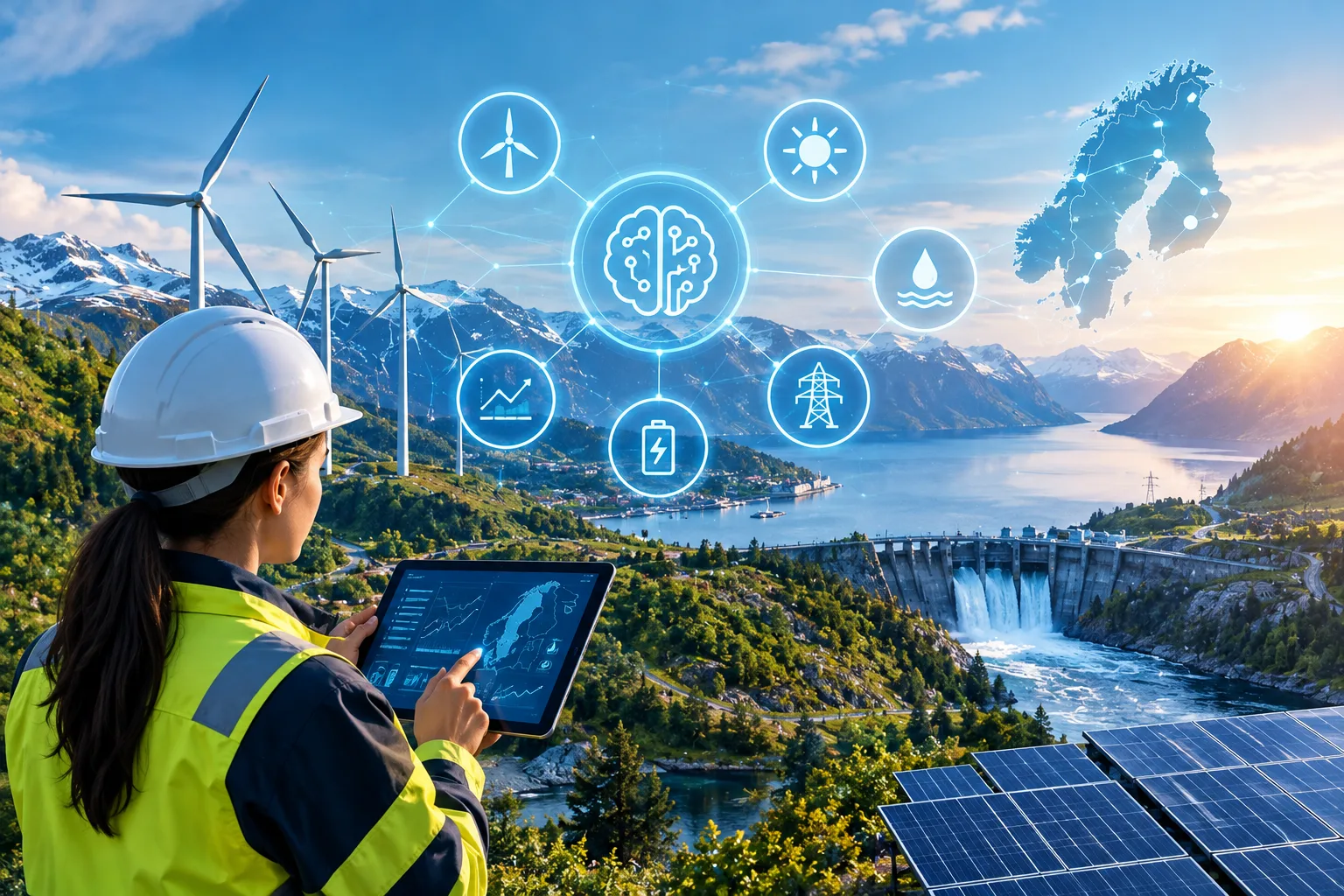
AI in Nordic Energy
Introduction: Why AI matters for Nordic energy
The Nordic countries—Denmark, Finland, Iceland, Norway and Sweden—have energy systems shaped by cold winters, strong digital skills, cross-border electricity links and different renewable resources. Hydropower is important in Norway and Sweden, wind power has a major role in Denmark and is growing across the region, and geothermal energy is central to Iceland’s energy supply. The mix is not identical in every country, but the region shares a common challenge: it must provide reliable and affordable energy while reducing emissions and meeting new demand from transport, industry and digital services.
Artificial intelligence (AI) can help with this challenge. AI refers to computer systems that learn patterns from data and use them to make predictions, identify problems or recommend actions. In energy, it can analyse weather forecasts, electricity use, equipment readings and market information much faster than people can do manually. It does not create energy by itself. Instead, it can help energy companies plan and operate existing assets more effectively.
Nordic Energy Research highlighted AI as a key topic in its 2026 Nordic Energy Challenge, focusing on smarter and more inclusive energy systems. Its work points to opportunities in grid digitalisation, renewable forecasting, energy use and public trust. The International Energy Agency (IEA) also reports that AI can improve forecasting, fault detection, asset management and the use of electricity networks, although benefits depend on safe and responsible deployment.
The important question is therefore not simply whether the Nordics should use AI. It is how they can use it to improve energy services while protecting people, infrastructure and the environment.
1. Understanding AI in the energy sector
Energy systems produce large amounts of data. Weather stations measure wind speed and temperature; smart meters record electricity use; sensors monitor power lines and turbines; and control centres track supply and demand. AI tools can combine these sources to find patterns that may be difficult to notice with traditional methods.
Different methods suit different tasks. Machine learning learns from past examples, such as electricity demand on cold days. Forecasting models estimate what may happen next. Computer vision can examine images to help identify damage or wear on equipment. Optimisation tools compare possible actions and recommend a lower-cost or more efficient choice. These methods are not all the same, and a simple model may be better than a complex one when the task is narrow.
AI should be treated as a support tool, especially when decisions affect the safety of a power system. Human operators still need to understand the recommendations, check unusual results and take responsibility for important decisions. The IEA notes that trust, auditability, cybersecurity and clear fallback rules become more important as AI moves closer to real-time grid control.
2. Forecasting renewable energy more accurately
Wind and solar power depend on weather. Their output can change over hours or even minutes, while electricity demand also changes throughout the day. If operators know that wind production is likely to rise or fall, they can plan other generators, storage and electricity exchanges in advance. Better forecasts can reduce the need for expensive last-minute balancing and can help avoid wasting renewable electricity.
AI models can learn from weather forecasts, historical generation, turbine performance and local conditions. For example, a wind farm operator can use a model to estimate the power that turbines are likely to produce tomorrow. A solar operator can combine cloud forecasts with past output to estimate generation for the next few hours. These predictions are not perfect, but they can be updated as new data arrives.
This is particularly useful in Denmark, where wind power is a major part of the electricity mix. It also matters in Norway and Sweden, where wind generation interacts with hydropower. Reservoir hydropower can often be adjusted more flexibly than weather-dependent generation, but water is still a limited resource and must be managed across seasons. More accurate wind and demand forecasts can help operators decide when to save water, generate electricity or trade power across borders.
AI can also help detect poor-quality data and compare forecasts with actual output. However, the model must be tested during unusual weather, including storms, very cold periods and changing climate conditions. If a model has mostly learned from normal years, it may be less reliable during rare events.
3. Smarter electricity grids and system reliability
Electricity grids must balance supply and demand while keeping voltage and frequency within safe limits. The task is becoming more complex as renewable generation, electric vehicles, heat pumps, batteries and large data centres connect to the grid. Building new lines is important, but it can take years. Digital tools may help operators use existing infrastructure more efficiently while new capacity is planned.
AI can support grid operators in several ways. It can estimate demand, detect unusual patterns that may signal a fault, help inspect equipment and compare possible responses to a network problem. It can also help operators understand where the grid may have spare capacity and when that capacity can be used safely. The IEA’s 2026 report on modernising electricity grids describes AI as one part of a wider toolkit that includes sensors, digital control systems and grid-enhancing technologies.
Norway offers a useful example of research in this area. Statnett, Norway’s transmission system operator, has described research using reinforcement learning to calculate possible responses to faults in the high-voltage grid. The goal is to provide decision support and faster analysis of difficult operating situations, not to remove the need for expert oversight. Statnett has also reported work on machine-learning models to improve short-term electricity load forecasts. These examples show how AI can be applied to practical system challenges.
Grid reliability also depends on cooperation between countries. The Nordic electricity systems are interconnected, so an event or imbalance in one area can affect flows elsewhere. Shared data standards, compatible tools and clear responsibilities can help AI systems support cross-border operation. At the same time, a model trained in one country may not work equally well in another because generation, weather, regulations and grid conditions differ.
4. AI in district heating and energy use
In cold Nordic climates, heating is a major part of everyday energy use. District heating supplies heat to many homes and buildings through a network of insulated pipes. Heat may come from combined heat and power plants, industrial waste heat, large heat pumps, electric boilers, biomass or other sources. Managing this mix efficiently can reduce costs and emissions.
AI can estimate how much heat customers will need based on weather, time of day, building use and previous demand. It can then help operators decide how much heat to produce, which equipment to run and when to charge or discharge heat storage. This can reduce unnecessary production and make it easier to use lower-carbon sources when they are available.
Fortum has described AI systems that forecast customer heat demand, guide the use of storage and support control-room decisions about heating assets. The company has reported using these approaches in district-heating systems in Finland and other European markets. This is a real-world example of AI supporting the operation of a complex energy service.
District heating can also support the wider electricity system. When wind power is plentiful and electricity prices are low, large heat pumps or electric boilers can convert electricity into heat and store it for later. AI can help decide when this is useful. The IEA has highlighted the role of district heating, heat pumps and thermal storage in connecting electricity and heat systems, including examples in Denmark and Finland.
The benefits depend on local conditions. A system needs good sensors, reliable data, suitable storage and equipment that can respond to control signals. Poor forecasts can lead to excess heat production or discomfort for customers, so energy savings should be measured rather than assumed.
5. Country perspectives: one region, different strengths
Denmark: balancing wind and flexible heat
Denmark’s high use of wind power makes forecasting and flexibility especially important. AI can improve estimates of wind output and electricity demand, while smart controls can help district-heating networks use electricity when renewable generation is plentiful. The aim is to connect electricity and heat more closely, rather than treating them as separate systems.
Finland: heating, storage and digital energy services
Finland has a strong need for reliable heating during cold periods. AI can support heat-demand forecasting, equipment maintenance and the coordination of heat pumps and thermal storage. The growth of data centres also creates a new opportunity: some of the electricity they use becomes heat that may be recovered and supplied to nearby buildings when the temperature and location are suitable.
Norway: hydropower and grid decision support
Norway’s hydropower resources can help balance variable electricity generation, but water must be managed carefully over time. AI-based forecasts can help estimate demand and renewable output, while research by Statnett explores faster analysis of grid faults and operating conditions. Such tools can support planning, but decisions must still respect grid safety and reservoir constraints.
Sweden: forecasting and a changing electricity system
Sweden combines hydropower, nuclear power, wind power and growing electricity demand from industry. AI may help forecast generation and demand, monitor grid assets and plan flexibility services. A 2026 analysis published by Energiforsk identifies forecasting, flexibility services and digital twins as areas where AI could influence the Swedish energy system, while also stressing the need to consider risks and skills.
Iceland: geothermal energy and remote infrastructure
Iceland’s energy system is distinctive because geothermal energy and hydropower are central to electricity and heating. AI could help monitor geothermal wells and power equipment, predict maintenance needs and match energy use to available supply. These are promising applications, but the value of each one depends on local data, equipment and operating practice; they should not be treated as proof that every Icelandic energy operator already uses AI.
6. The other side of the story: AI also uses energy
AI is not automatically climate-friendly. Training and running AI models requires computers, data centres, cooling and electricity. As AI services grow, data centres can add significant demand to local grids. The IEA’s 2025 report on Energy and AI stresses this two-way relationship: AI can help improve energy systems, but the expansion of AI itself creates new electricity needs.
This issue is especially relevant to a region that wants to attract digital businesses while keeping energy affordable and low-carbon. A data centre may support jobs and innovation, but it can also compete with homes, transport and industry for limited grid capacity. The Nordic transmission system operators reported in 2026 that requests for new grid connections were rising sharply and that demand for capacity exceeded what was available in the short to medium term. AI growth is one part of a wider increase in electricity demand, so planning should consider all major users.
One idea under discussion is to make some computing tasks flexible. Tasks that do not need an immediate result could be scheduled for times or locations where renewable electricity is more available and the grid is less constrained. Nordic Energy Research highlighted this approach among the proposals considered in its 2026 Nordic Energy Challenge. It is a proposal for better coordination, not a guarantee that all AI workloads can be moved easily; latency, data security and business needs may limit flexibility.
Energy use is not the only environmental concern. Data centres may also require water for cooling and materials for hardware. A responsible approach should measure the full footprint of AI services and prioritise applications whose benefits are clear.
7. Risks, barriers and responsible use
AI systems can make mistakes. A model may perform well on past data but fail when weather patterns, customer behaviour or equipment conditions change. Incorrect forecasts can lead to poor scheduling, higher costs or unsafe recommendations. Operators should test models against difficult scenarios, monitor their performance and keep a reliable backup process.
Cybersecurity is another major concern. Connected sensors, software platforms and automated controls can create more entry points for attackers. If data are altered or an AI system is manipulated, its recommendations may become unreliable. The Nordic grid research agenda has therefore included digital vulnerability, automatic control and preparedness for cyberattacks as important topics.
There are also questions about privacy and fairness. Smart meters and building systems can reveal details about how people live and when they are at home. Data should be collected only for clear purposes, stored securely and shared under suitable rules. Customers should be able to understand how automated systems affect their bills or services.
Finally, AI needs skilled people, good-quality data and clear accountability. Smaller utilities may not have the same resources as large companies. Cooperation between universities, public agencies, energy firms and technology providers can help share knowledge, but it should not lead to one-size-fits-all solutions. The best model is the one that works safely in the actual system, not necessarily the most advanced one.
8. What should happen next?
The Nordic region can build on its renewable resources, digital infrastructure and history of cooperation. To turn AI’s promise into measurable results, energy organisations should focus on practical steps:
- Start with a clear problem, such as reducing heat waste, improving a forecast or finding equipment faults earlier.
- Use trustworthy data and test the model against simple methods, including the system already in place.
- Measure results using clear indicators: forecast error, energy use, cost, emissions, outage time and customer comfort.
- Keep human oversight for high-impact decisions, with clear limits and a safe fallback when the AI is uncertain.
- Share lessons across Nordic countries while respecting differences in laws, grid design, climate and energy mix.
- Include the electricity, water and carbon costs of AI itself when deciding whether a project is worthwhile.
Regional collaboration is particularly valuable because electricity systems are connected and many challenges are shared. Nordic Energy Research’s 2026 work calls for digitalisation that supports resilience, transparency and public trust, while also recognising AI’s own resource use. A coordinated approach could help countries test ideas, agree on useful standards and avoid repeating the same mistakes.
Conclusion: AI should serve the energy transition
AI can help the Nordic energy sector become more efficient and responsive. It can improve renewable-energy forecasts, support grid operators, predict equipment problems and help heating networks use energy more wisely. Examples from Statnett and Fortum show that AI is already being explored and applied in practical energy tasks.
However, AI is not a replacement for power lines, storage, renewable generation, skilled workers or sound energy policy. It also creates new electricity demand and introduces risks related to safety, privacy and cybersecurity. Its value should be judged by real outcomes: a more reliable system, lower waste, fair services and reduced environmental impact.
The most promising future is not one in which every energy decision is handed to a machine. It is one in which AI gives people better information, helps systems respond sooner and supports responsible choices. If the Nordic countries combine innovation with careful testing, clear rules and cooperation, AI can become a useful tool for a cleaner and more resilient energy future.