

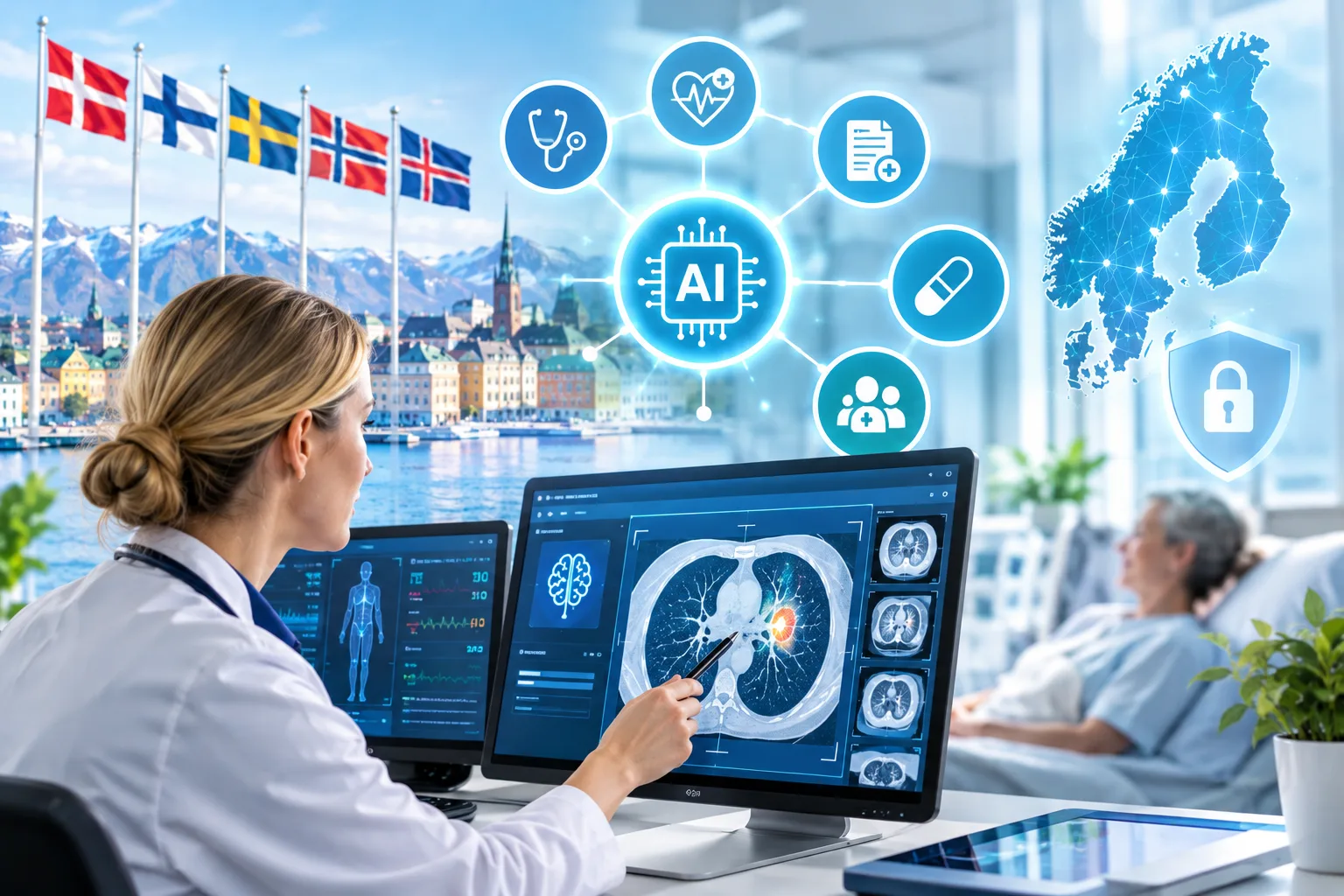
AI in Nordic Healthcare: How the Region is Leading the Future of Medicine
Artificial intelligence is quietly transforming healthcare across the Nordic countries, turning decades of digital health infrastructure into real-world tools that support doctors, improve diagnostics, and free up time for patient care. From speech recognition in Swedish clinics to AI-powered image analysis in Finnish hospitals, the Nordic region has become one of the world's most advanced testbeds for responsible, data-driven healthcare innovation.
Why the Nordics Are Uniquely Positioned
The Nordic countries - Denmark, Finland, Iceland, Norway, and Sweden - share something rare: universal healthcare systems backed by decades of digitized, linkable health registries. This means patient data, when properly anonymized and governed, can be used to train AI models that learn from entire populations rather than fragmented samples. Combined with strong public trust in digital services and early national AI strategies (Sweden led in 2018, followed by Denmark and Finland in 2019, and Norway in 2020), the region has created fertile ground for scaling AI in health.
A 2026 survey mapped more than 800 AI initiatives across publicly funded Nordic healthcare, revealing that roughly one-third are already in routine operation. This isn't speculative futurism - it's happening in radiology departments, administrative offices, and primary care clinics today.
Real-World Applications Already in Use
The single largest category of AI use in Nordic healthcare is clinical care and diagnostics, which also has the highest number of fully implemented projects. Here are some of the most impactful applications:
- Medical imaging and diagnostics: AI tools assist radiologists in detecting tumors and anomalies across multiple hospitals, improving speed and consistency without replacing human judgment.
- Speech recognition: Automated transcription frees clinicians from manual note-taking, allowing more face-to-face time with patients.
- Automated monitoring: Systems track patient vitals and flag early warning signs, reducing routine manual checks and enabling faster interventions.
- Administrative support: AI streamlines scheduling, documentation, and resource allocation, addressing staffing pressures and operational bottlenecks.
These tools are not isolated experiments. The Nordic AI Health Map - an interactive platform launched in 2026 - shows initiatives ranging from concept to daily use across all five countries, helping hospitals learn from each other's successes.
National Strategies and Collaborative Infrastructure
Each Nordic country has embedded AI into its national health and digital strategies, but the region's real strength lies in collaboration. Sweden hosts the Centre for AI Innovation at Karolinska Institute, a hub for developing and evaluating next-generation health AI models in partnership with academia, industry, and public-sector stakeholders. The Swedish node of TEF-Health (the European Testing and Experimentation Facility for Health AI and Robotics) supports real-world validation and regulatory readiness of AI solutions.
Proposals are underway for a unified Nordic AI-Health Infrastructure that would enable secure, regulation-compliant access to large-scale longitudinal health datasets across the region. This platform aims to develop generalizable, trustworthy AI models that can be deployed across different healthcare systems while respecting privacy and ethical standards.
Challenges and Barriers to Adoption
Despite progress, AI's impact in Nordic healthcare remains limited relative to its potential. Key barriers include:
- Fragmentation: Many pilot projects run in parallel without coordination, leading to duplicated efforts and missed opportunities for scaling.
- Regulatory and ethical complexity: Ensuring compliance with GDPR, medical device regulations, and ethical guidelines slows deployment, even when the technology is ready.
- Workforce readiness: Clinicians need training and support to integrate AI tools into daily workflows effectively.
- Data governance: While registries are rich, linking and sharing data across borders requires robust legal frameworks and public trust.
Nordic governments frame AI as essential to addressing staffing crises, rising costs, and growing demand - but translating strategy into routine care remains a work in progress.
The Human Element: AI as a Partner, Not a Replacement
Nordic healthcare leaders emphasize that AI is not about replacing doctors but augmenting their capabilities. Algorithms help organize and sort data, identify patterns in medical images, and predict illness risks - but clinical judgment, empathy, and ethical decision-making remain firmly human domains.
This human-centered approach is reflected in national strategies that prioritize "safe, secure, and ethical consideration" from the earliest stages of AI design, not as an afterthought. Public communication focuses on transparency: patients are informed about how AI supports their care, and clinicians retain final authority over diagnoses and treatment plans.
What's Next for AI in Nordic Healthcare?
The trajectory is clear: AI will expand in scale and scope across Nordic health systems, driven by demographic pressures, technological maturity, and cross-border collaboration. Expect to see:
- More routine deployments: As pilots mature, successful tools will move from single clinics to regional or national rollouts.
- Deeper integration: AI will move beyond diagnostics into preventive care, personalized treatment planning, and population health management.
- Stronger infrastructure: Shared data platforms, testing facilities, and regulatory sandboxes will accelerate responsible innovation.
- Greater equity: Universal healthcare systems can ensure AI benefits reach all patients, not just those in well-resourced urban centers.
The Nordic AI Health Map will continue to evolve as a living resource, helping healthcare workers discover what's already working elsewhere and avoid reinventing the wheel.
Lessons for the Rest of the World
The Nordic experience offers valuable lessons for other regions exploring AI in healthcare:
- Invest in digital foundations first: Decades of digitized health registries made AI feasible at scale.
- Coordinate, don't fragment: National strategies and shared platforms prevent duplication and enable learning.
- Prioritize ethics and trust: Public support depends on transparency, privacy, and human oversight.
- Start with high-impact, low-risk use cases: Speech recognition and image analysis deliver immediate value while building confidence.
- Think regionally: Cross-border data sharing and collaboration multiply the value of AI investments.
Final Thoughts
AI in Nordic healthcare is not a distant promise - it's a present reality shaping how doctors work, how patients are diagnosed, and how systems manage resources. With strong data foundations, collaborative infrastructure, and a commitment to ethical, human-centered design, the Nordic countries are demonstrating how AI can enhance - not replace - the core values of universal, equitable healthcare.
As the region moves from pilots to scale, the rest of the world will be watching closely. The Nordic model shows that when technology serves people, and when innovation is grounded in trust and transparency, AI can help build healthcare systems that are not only smarter but also more humane.