

Build vs Buy AI Solutions: A Practical Guide for Teams
How to choose between buying, building or combining the two, and how to test the choice before committing.
Once a team decides to use AI on a real business problem, a familiar question comes up early: should we build the solution ourselves, buy a product that already does the job, or combine the two?
Software teams have argued about build versus buy for decades, but AI makes the choice harder. Models improve quickly, so something built this year can be overtaken by a general-purpose model next year. Much of the effort sits outside the model itself, in data preparation, integration, testing and monitoring. And the word "build" covers very different kinds of work, from connecting a hosted model to your own documents to training a new model from scratch.
This guide looks at what the most widely cited recent research actually found, what each option really involves, and a practical way to decide, including a short pilot before any major commitment.
What the research found, and what it didn't
A data point that comes up often in this debate is The GenAI Divide: State of AI in Business 2025, published by MIT's Project NANDA in July 2025 [1]. Between January and June 2025, the authors reviewed more than 300 publicly disclosed AI initiatives, interviewed representatives of 52 organisations and collected survey responses from 153 senior leaders at four industry conferences.
Two findings received the most attention. The first was the headline that 95% of organisations were getting zero return from generative AI. The second concerned sourcing: according to the report, initiatives delivered through external partnerships reached deployment about 67% of the time, compared with about 33% for internally built tools. The authors summarise this as external partnerships having roughly twice the success rate of internal builds.
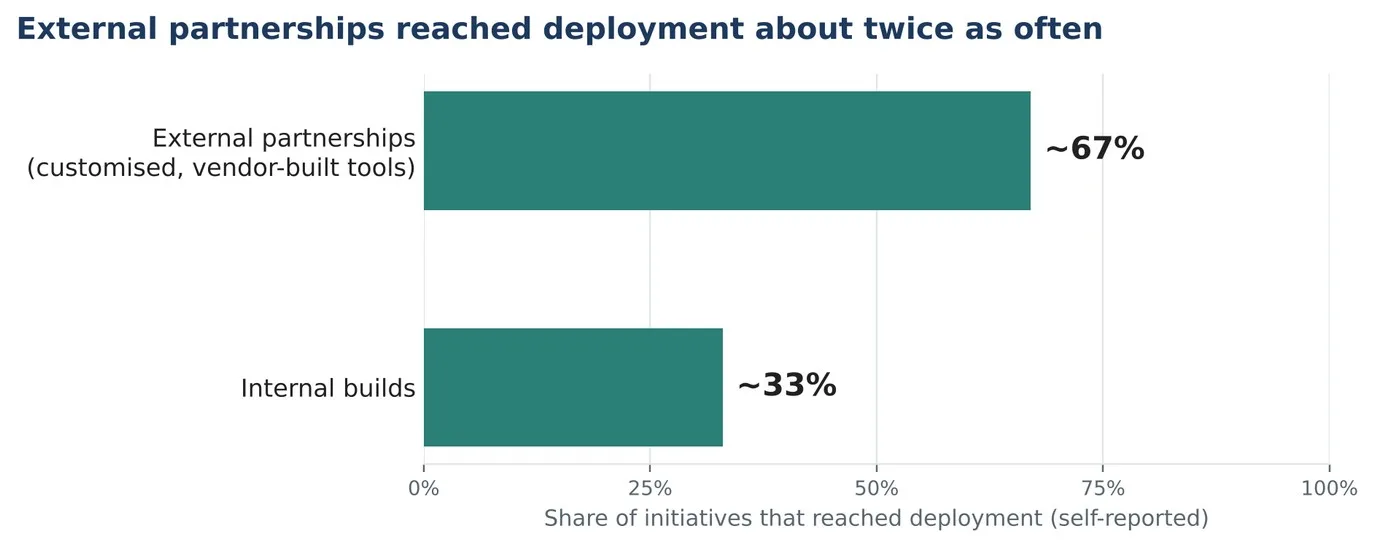
Figure 1. Self-reported deployment rates by sourcing approach, as reported in MIT NANDA (2025) [1]. The report's exhibit shows 66% for external partnerships; its text rounds this to about 67%.
Both findings need careful reading before they inform a decision.
What "success" meant. The report defines success as deployment beyond the pilot phase with measurable KPIs, with return on investment assessed six months after the pilot. For task-specific tools, it counted an implementation as successful when users or executives described a marked and sustained effect on productivity or profit and loss. A project without measurable financial impact in that window hasn't necessarily failed. It may still be maturing, its benefits may be hard to quantify, or nobody may have measured them.
How strong the evidence is. The authors describe their figures as directionally accurate, drawn from interviews rather than official company reporting, and note that organisations defined success differently. They also state that the link between external partnerships and success doesn't prove causation and may reflect the capabilities of the organisations involved rather than the sourcing approach itself. Hybrid approaches couldn't be quantified because there wasn't enough data.
What "buying" meant. The successful external projects in the report involved customised tools that could learn and adapt to the customer's workflow, typically delivered through a partnership. That's quite different from licensing a generic product and leaving it untouched.
A note on the numbers. Some coverage, including Fortune's widely shared article [2], said internal builds succeeded "one-third as often" as purchased tools. The report's own figures, about 67% against 33%, mean internal builds reached deployment about half as often. This guide uses the report's figures.
The fair conclusion is a modest one. In this sample, internally built generative AI tools reached deployment less often than externally partnered ones. That's a useful warning about how much work building takes, but it isn't evidence that buying is better in every situation.
What "build" and "buy" really mean
Framing the decision as a binary choice hides most of the real options. In practice, teams choose a point on a range, and the costs and risks change considerably from one point to the next.
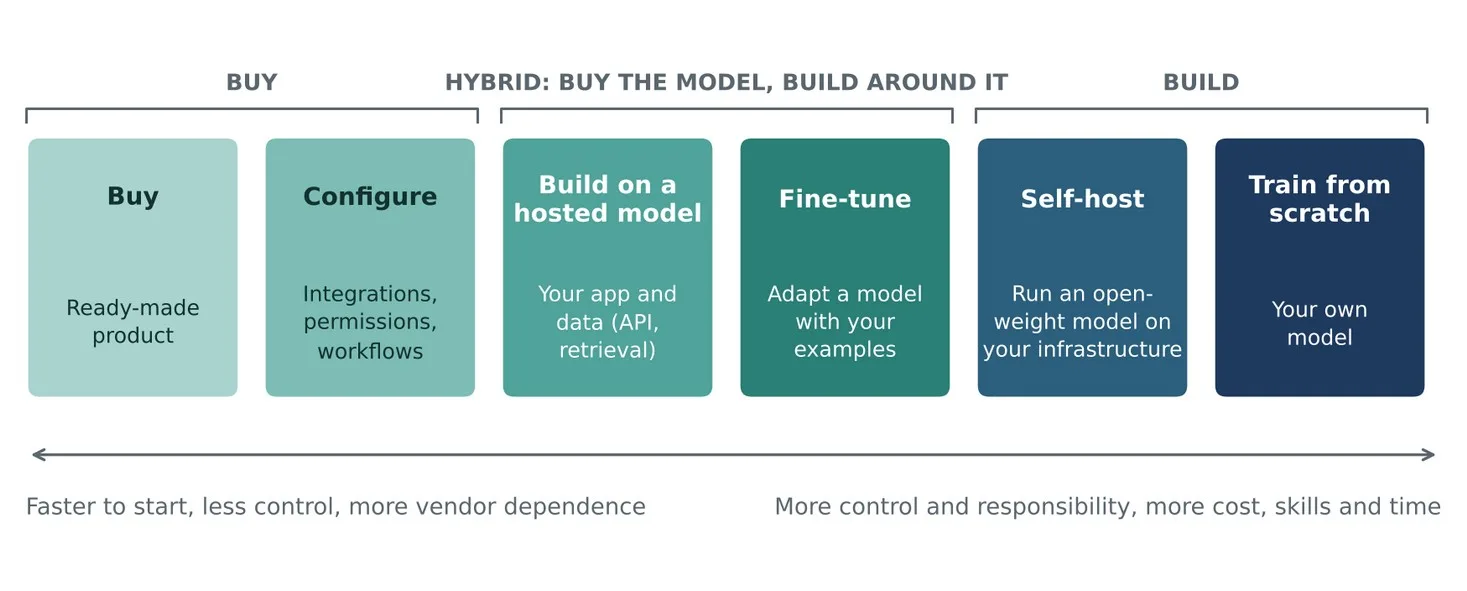
Figure 2. The range of options. Most teams that say "build" mean building an application around a model they access through an API.
The four kinds of "build" are worth separating, because they're often discussed as if they were the same thing.
| Approach | What you own | What you still depend on | Typical fit |
|---|---|---|---|
| Application on a hosted model | Application logic, prompts, retrieval pipeline, integrations, evaluation and user experience | The model provider's quality, pricing, availability and terms | A common starting point for custom AI products and internal tools |
| Fine-tuning | Training examples, tuning runs, evaluation and versions of the tuned model | The base model and, often, the provider's tuning service | Specialised tasks or consistent formats where prompting and retrieval fall short |
| Self-hosting an open-weight model | Infrastructure, scaling, security patching and model upgrades | The model's licence terms and future releases | Strict data-location requirements, high and steady volume, or offline use |
| Training from scratch | Data, compute, research, safety testing and everything that follows | Specialist talent and large amounts of compute | Rarely justified outside organisations whose core business is AI |
Where buying fits, and what it doesn't take off your plate
Buying usually makes sense when the problem is common, the workflow looks similar across organisations, and speed matters more than differentiation. Meeting summaries, document search, coding assistance and first-line customer support are typical examples. A vendor serving many customers will often have already dealt with the edge cases, scaling problems and model upgrades that your team would otherwise have to work through.
Buying doesn't mean giving up on your own data, either. Many platforms let you connect internal documents and systems, ground answers in your content, or adjust behaviour for your use case. What's possible depends on the product's features and on the contract, so check how your data is stored and processed, where it's located, how long it's retained, whether it can be used to train the vendor's models, and how you can get it back.
What buying doesn't do is transfer responsibility. Your organisation still has to:
- set up access controls and data permissions correctly
- assess privacy and regulatory obligations for the data you send to the tool
- integrate the tool with existing systems and workflows
- test output quality on your own cases, both at launch and after vendor updates
- decide who reviews AI outputs, and how errors are reported and corrected
- train staff and monitor how the tool is actually used
Frameworks such as the NIST AI Risk Management Framework [3], a voluntary framework organised around four functions (Govern, Map, Measure and Manage), are useful here regardless of who built the tool.
Where building fits, and what it doesn't guarantee
Building, or building on top of a purchased model, becomes more attractive when:
- the AI capability is central to your product or to how you compete
- your data or process knowledge meaningfully improves results, and the products you've evaluated can't use it well
- the workflow is specific enough that no product fits without heavy workarounds
- you need control over the user experience, the choice of model or where the system runs
- usage is high and predictable enough that per-seat or per-call pricing becomes expensive, which is worth checking with real numbers rather than assumptions
Building has limits that are easy to overlook, though. Running a system yourself doesn't make it compliant. Instead, you take on the work of designing controls, documenting decisions and demonstrating them to auditors or regulators. Control is also partial unless you self-host, since an application built on a hosted model still depends on that provider's pricing, availability and model changes. And long-term costs aren't automatically lower. The first version is only part of the bill: evaluation, monitoring, retrieval maintenance, security updates, migrations to newer models and on-call support continue for as long as the system runs.
Comparing the options
The table below summarises how the three broad approaches usually compare. Treat it as a starting point, since individual products and projects vary widely.
| Factor | Buy | Hybrid | Build |
|---|---|---|---|
| Time to a first useful version | Usually shortest | Moderate | Usually longest |
| Upfront cost | Low | Moderate | High |
| Ongoing cost | Licence or usage fees that grow with adoption | Model or API fees plus engineering time | Engineering, infrastructure and maintenance staff |
| Internal skills needed | Procurement, integration and governance | Software, data and evaluation skills | All of these, plus ML engineering and operations |
| Control and customisation | Limited to what the product allows | High at the application level; model chosen from providers | Highest, especially when self-hosted |
| Use of your own data | Within product features and contract terms | Through retrieval and integrations you design | Any approach you can engineer and govern |
| Vendor dependence | High | Moderate, mainly on the model provider | Lower, but higher dependence on key staff |
| Data portability | Depends on export options and formats | Your data and code stay portable; tuned assets may not | Generally highest |
In every column, security, privacy, evaluation and human oversight remain your organisation's responsibility.
A practical way to decide
A clear process matters more than any single rule of thumb. The five steps below keep the decision tied to evidence rather than to an impressive demo or enthusiasm for building.
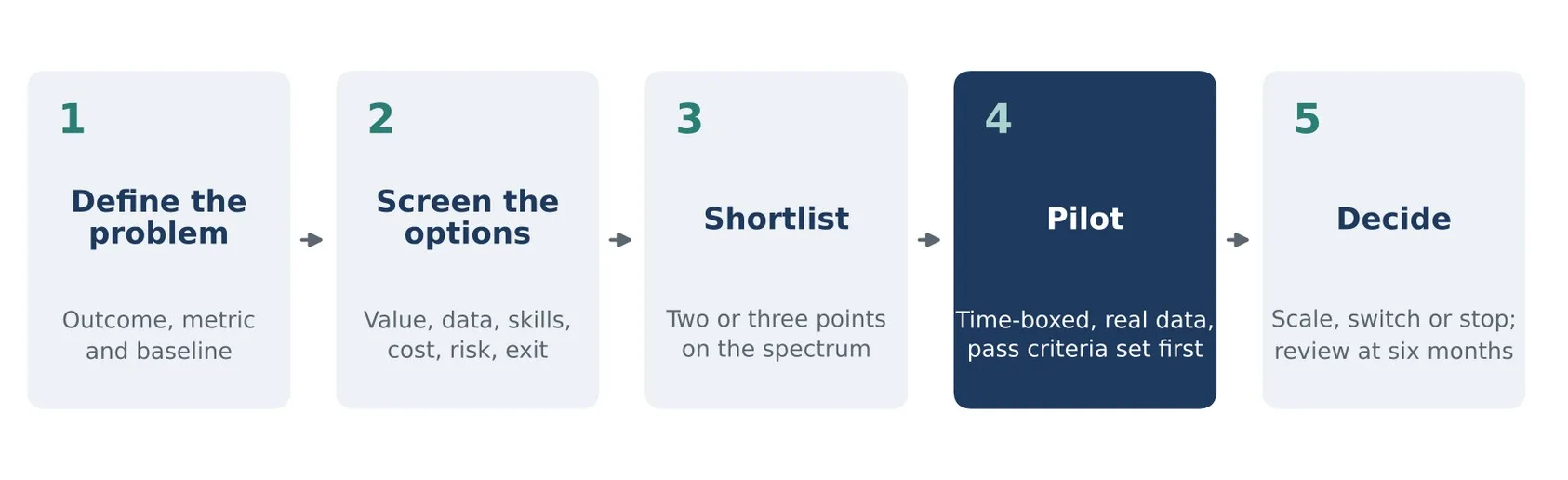
Figure 3. A five-step decision process with a pilot before any major commitment.
1. Define the problem and how you'll measure it
Write down the business outcome you want, the metric that shows it, and today's baseline. If you can't measure the current state, you won't be able to tell whether either option worked.
2. Screen the options with specific questions
| Area | Questions to answer |
|---|---|
| Value | What measurable result are we aiming for, and what is it worth if we achieve it? |
| Differentiation | If a competitor bought the same tool tomorrow, would it matter to our position? |
| Data | Does our data improve results? Can a purchased product use it under terms we accept? |
| Skills | Who will build, evaluate and maintain this, and will they still be here in two years? |
| Total cost | Over three years, what are the licence or API fees, engineering time, infrastructure, evaluation, support and eventual migration costs for each option? |
| Time | When does this need to deliver results, and is that realistic for each option? |
| Dependence and exit | What happens if the vendor raises prices, changes its model or closes? Can we export our data, prompts, logs and configuration? |
| Risk | Which regulations apply? What does a wrong output cost, and who reviews outputs before they matter? |
3. Shortlist two or three options
Pick points from different parts of the range, for example a ready-made product and an application built on a hosted model, so the pilot compares genuinely different approaches.
4. Run a short, time-boxed pilot
Use real data, real users and the same evaluation set for every option. Agree pass criteria before the pilot starts, such as accuracy on a test set, time saved per task, cost per task, adoption by the target users and the outcome of a security review. A few weeks is often enough to separate the options, and agreeing the criteria in advance stops the team from arguing about the results afterwards.
5. Decide, then review
Scale the option that met the criteria, switch to another, or stop. Then check results against the baseline again after about six months, which is also the window the MIT NANDA study used for assessing return on investment.
Two hypothetical examples
The two examples below show how this process might play out. They are invented to illustrate the reasoning and don't describe real organisations.
Example A (hypothetical): buying fits
A 60-person accounting firm wants staff to find answers in its internal policies and templates faster, and to draft routine client emails. It has no machine learning staff, and the need is much the same as at thousands of other firms.
The firm shortlists two enterprise AI assistants that can connect to its document store. Before signing, it confirms the vendors' data retention and training terms, checks that the tools respect existing folder permissions, and runs a four-week pilot with 15 staff. Both tools are tested on the same 50 real questions, and the firm tracks answer accuracy, time saved and weekly usage. It picks the tool that performs better and assigns a partner to review accuracy each quarter.
Example B (hypothetical): a hybrid approach fits
A regional logistics company competes on how quickly it resolves delivery exceptions, such as failed drops or damaged goods. Resolving them requires shipment history, driver notes and customer-specific service agreements, and the support tools it evaluates can't connect to its in-house dispatch system.
The company builds a small application on a hosted model: it retrieves the relevant records, drafts a resolution and lets agents approve or edit it in the dispatch system. It buys the model and builds the workflow, and leaves fine-tuning until retrieval and prompting have clearly reached their limits. A pilot at one depot compares resolution time and error rates with the previous quarter before the system is rolled out further.
Keeping the decision open
A build-or-buy decision doesn't have to be permanent. A purchased tool can show you which parts of a workflow matter most, which is exactly what you'd need to know before investing in a custom system. A custom system can later swap a component you built for a product that does the job well. Keeping data exportable and integrations clean makes either move easier.
The research covered here suggests that building generative AI tools in-house is harder than many teams expect, but it doesn't settle the question for any particular organisation. What's most likely to hold up is a decision based on a clear metric, tested on real work and reviewed once the results are in.
References
- Challapally, A., Pease, C., Raskar, R. and Chari, P. (2025). The GenAI Divide: State of AI in Business 2025. MIT NANDA, July 2025.
- Estrada, S. (2025). "MIT report: 95% of generative AI pilots at companies are failing." Fortune, 18 August 2025.
- National Institute of Standards and Technology (2023). Artificial Intelligence Risk Management Framework (AI RMF 1.0), released 26 January 2023.