

EU AI Act for Nordic Companies: What It Means and What to Do Now
Nordic companies have spent the last few years adopting AI faster than almost anyone in Europe. Now a new question is landing on every leadership team's desk: can we prove that our AI is safe, fair and well governed?
That is what the EU AI Act asks. It is the world's first broad law for artificial intelligence, and its main rules have applied since 2 August 2026. At the same time, the rules have just changed. In July 2026, the EU adopted the Digital Omnibus on AI, which pushed back some of the biggest deadlines and softened a few obligations (European Commission).
Meanwhile, readiness in the region is low. In Tieto's 2026 Nordic AI Survey of more than 600 IT decision-makers, only 3% said they feel fully prepared for the AI Act (Tieto). And because Norway and Iceland are EEA countries, not EU members, the rules do not even arrive in every Nordic country at the same time.
So the central question for Nordic leaders is simple: what does the AI Act actually require from us, and what should we do first?
In this article, we'll cover:
- What the EU AI Act is and how its risk levels work
- The key dates after the Digital Omnibus
- How the Act is being applied in Denmark, Finland, Sweden, Norway and Iceland
- How ready Nordic companies are today
- What the Act means for common business use cases
- Fines, AI literacy and general-purpose AI
- A practical roadmap to get compliant without slowing down
What Is the EU AI Act?
The EU AI Act (Regulation (EU) 2024/1689) is a law that sets rules for organisations that build, sell or use AI systems in the EU. It does not regulate AI as a technology. It regulates how AI is used, based on how much risk that use creates for people's safety and rights.
The European Commission describes four risk levels (European Commission):
| Risk level | What it means | Examples |
|---|---|---|
| Unacceptable risk | Banned | Social scoring, emotion recognition at work or in schools, untargeted scraping of facial images |
| High risk | Allowed, but with strict requirements | CV-sorting software, credit scoring, exam scoring, AI safety components in transport or medical devices |
| Transparency risk | Allowed, but people must be told | Chatbots must say they are AI; deepfakes and AI-generated content must be labelled |
| Minimal risk | No specific rules | Spam filters, AI in video games, most internal productivity tools |
Most AI in Nordic businesses is minimal or transparency risk. But many companies also use AI in high-risk areas such as recruitment or credit decisions, often without realising it.
Provider or deployer? Your role matters
The Act gives different duties to different roles. A provider develops an AI system or puts it on the market under its own name. A deployer uses an AI system in its own work. Most Nordic companies are deployers, for example when they use an HR platform with AI-based candidate ranking. But a company can become a provider if it builds its own AI product, puts its own brand on a high-risk system, or makes a substantial change to one.
The Act also reaches beyond the EU. A Norwegian or non-European company whose AI systems or AI outputs are used in the EU can fall within its scope.
Key Dates: The Timeline After the Digital Omnibus
The AI Act entered into force on 1 August 2024, but it applies in stages. In November 2025, the Commission proposed a "Digital Omnibus" to simplify the rules. A political agreement followed on 7 May 2026, and the amending regulation, Regulation (EU) 2026/1744, entered into force on 27 July 2026 (European Commission).
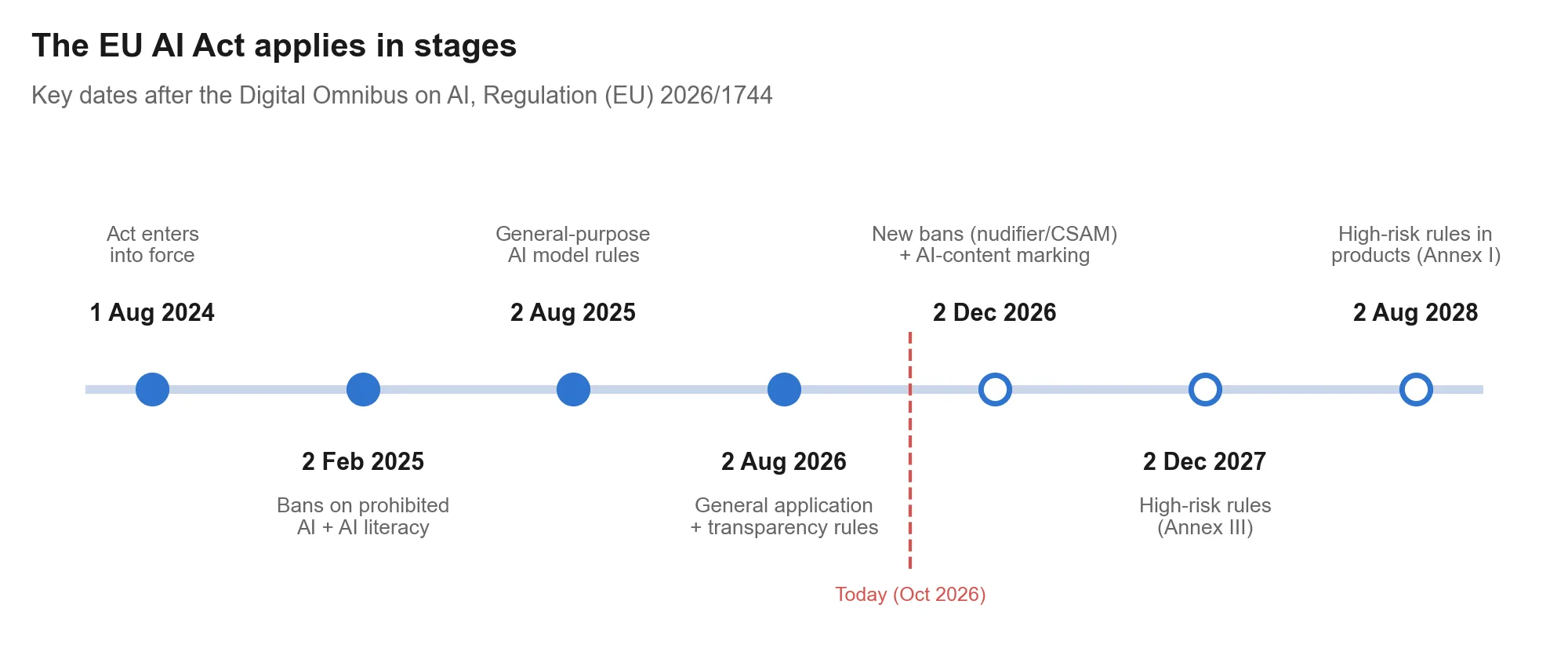
Source: European Commission, AI Act; Freshfields and Orrick summaries of the final Digital Omnibus on AI (2026)
The most important changes from the Omnibus are (Freshfields, Orrick):
- High-risk rules are delayed. Rules for stand-alone high-risk systems (Annex III, such as recruitment and credit scoring) now apply from 2 December 2027, not August 2026. Rules for AI built into regulated products such as machinery, toys or medical devices (Annex I) apply from 2 August 2028.
- New bans are added. AI systems that create non-consensual intimate images ("nudifier" apps) or child sexual abuse material will be prohibited from 2 December 2026.
- Transparency rules still apply now. Chatbot disclosure and other Article 50 duties have applied since 2 August 2026. Systems already on the market before that date have until 2 December 2026 to add machine-readable marking of AI-generated content.
- More relief for mid-sized companies. A new "small mid-cap" category (fewer than 750 employees and turnover up to €150 million or a balance sheet up to €129 million) gets simpler documentation and lower penalty caps, like SMEs.
- Sandbox deadline moved. Each country now has until 2 August 2027 to set up an AI regulatory sandbox.
💡 Why This Matters
The delay applies to high-risk systems only. The bans, AI literacy, rules for general-purpose AI models and transparency duties are already in force. "The AI Act was postponed" is a common and costly misunderstanding.
How the AI Act Works Across the Nordics

The AI Act is an EU regulation, so its main rules apply directly in every EU country. But each country must also pass national laws to name its supervisory authorities and set its penalty system. This is where the Nordic countries are taking different paths.
| Country | Status (October 2026) | Key authorities |
|---|---|---|
| Denmark (EU) | National supplementary law (Law No. 467 of 14 May 2025) in force since 2 August 2025, one of the earliest in the EU | Agency for Digital Government (Digitaliseringsstyrelsen), Data Protection Agency, Court Administration |
| Finland (EU) | National laws, including Act 1377/2025, in force since 1 January 2026 | Supervision split across about 15 authorities; Traficom coordinates; Data Protection Ombudsman covers banned practices |
| Sweden (EU) | Supplementary law proposed (SOU 2025:101) but delayed; temporary authority roles until 31 December 2026 | PTS (coordinator and contact point), IMY, Finansinspektionen, Läkemedelsverket, Swedac |
| Norway (EEA) | Not yet in Norwegian law; new public consultation planned for autumn 2026, bill aimed at spring 2027 | Nkom (coordinating supervisor), Datatilsynet |
| Iceland (EEA) | Waiting for the Act to be incorporated into the EEA Agreement | To be confirmed |
Sources: Danish law summary (ai-regulation.com), Finnish Government, Finnish Data Protection Ombudsman, Swedish Government, Norwegian Government (regjeringen.no)
Denmark, Finland and Sweden: three different models
Denmark was an early mover. Its supplementary law took effect on 2 August 2025, with the Agency for Digital Government as the main authority and single point of contact (summary of the Danish law). Finland's national laws took effect on 1 January 2026 (Finnish Government). Instead of one AI regulator, Finland spreads supervision across about 15 existing authorities, with Traficom coordinating (Data Protection Ombudsman). In Sweden, the proposed law was not ready by August 2026 (SOU 2025:101), so the government gave five authorities temporary roles until 31 December 2026, with PTS as the proposed coordinator (Swedish Government).
For businesses, this means your AI regulator is often the same authority you already know from your sector, such as your financial or data protection supervisor.
Norway and Iceland: the EEA difference
Norway and Iceland must first incorporate the AI Act into the EEA Agreement. Norway had planned for the law to apply from late summer 2026, but in August 2026 the government announced a new public consultation in autumn 2026 because of the EU's Omnibus changes. The Minister of Digitalisation aims to present the bill to the Storting in spring 2027, depending on EEA negotiations (Norwegian Government). Nkom has already been named as the coordinating supervisory authority.
⚠️ Practical Advice
Do not wait for Norwegian or Icelandic law if you sell into the EU. If your AI systems or their outputs are used in Denmark, Finland, Sweden or any other EU country, the EU rules already apply to that activity.
Are Nordic Companies Ready?
Nordic companies are among Europe's heaviest AI users. In 2025, 42% of Danish enterprises used AI, followed by Finland (37.8%) and Sweden (35%), compared with an EU average of 20% (Eurostat). But high adoption has not yet turned into high compliance readiness.
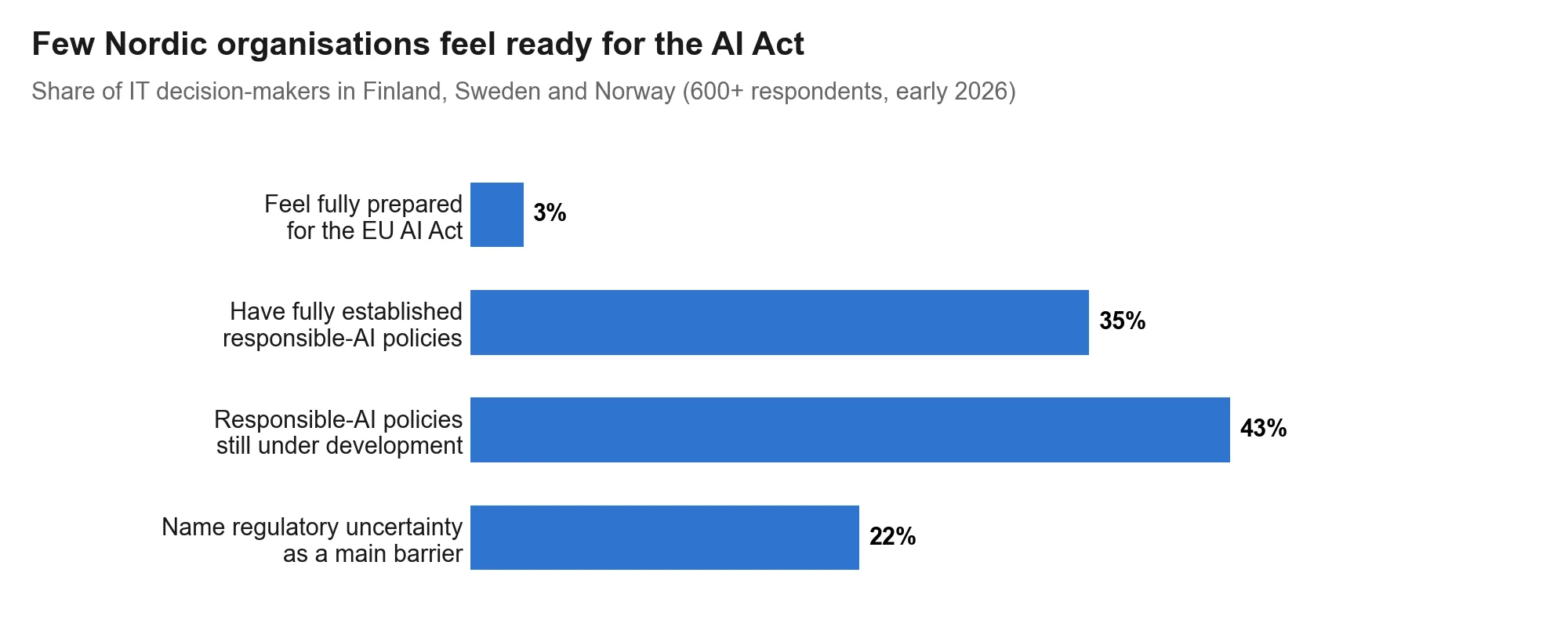
Source: Tieto, Nordic AI Survey 2026 (600+ IT decision-makers in Finland, Sweden and Norway)
Other studies show the same pattern:
- 84% of Nordic organisations see data privacy and security as a key AI concern (Deloitte, State of AI in the Nordics 2026).
- 74% of Nordic CxOs believe their AI controls are moderate or strong, but when measured against EY's nine responsible-AI principles, they are strong in only 3 of 9 areas on average (EY).
- 53% of Nordic companies find it hard to assign accountability for emerging AI technologies (EY).
- 45% name cybersecurity and 39% name skills gaps as main barriers to AI adoption (Tieto).
In short, many Nordic companies are using AI widely, but few have a clear view of which AI systems they use, what risk level each one has, and who is accountable for it. That is exactly what the AI Act asks for.
What the AI Act Means for Common Business Use Cases

The easiest way to understand the Act is to look at the AI your company already uses. Here are some typical examples:
| Use case | Likely category | What to do |
|---|---|---|
| Customer-service chatbot | Transparency risk | Tell users they are talking to AI (applies now) |
| AI-generated marketing images or video | Transparency risk | Label deepfakes; providers must mark AI content in machine-readable form |
| Internal copilots, coding assistants, knowledge search | Usually minimal risk | AI literacy, internal policy, data protection |
| CV screening and candidate ranking | High risk (Annex III) | Prepare for 2 December 2027: human oversight, logs, informing workers |
| Credit scoring of individuals | High risk (Annex III) | Prepare for 2 December 2027; coordinate with financial supervisors |
| Emotion recognition of employees | Prohibited (with narrow exceptions) | Stop now; banned since 2 February 2025 |
If your company uses a high-risk system as a deployer, you will need to follow the provider's instructions, assign trained people for human oversight, monitor how the system works, and keep the logs it creates. Employers must also inform workers' representatives and affected employees before using a high-risk AI system at work. With the Nordic tradition of strong employee co-determination, it makes sense to involve unions and works councils early.
Fines: What Is at Stake?
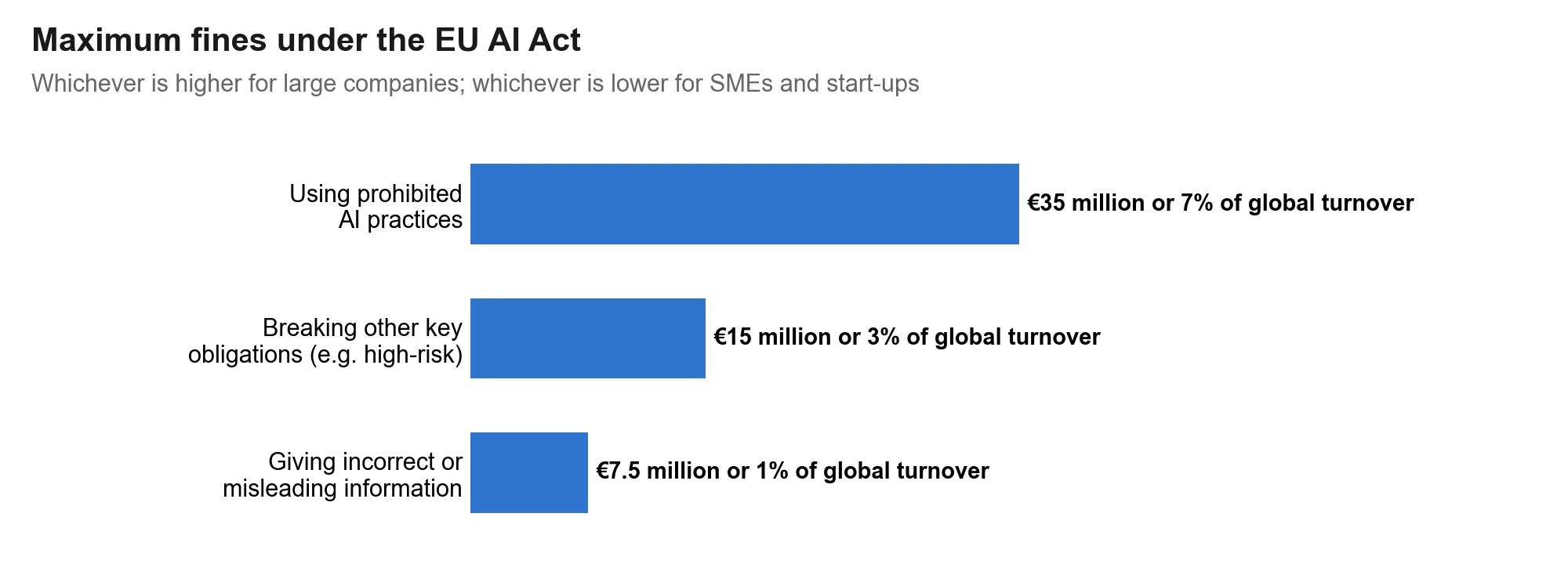
The AI Act has a three-level fine system (AI Act, Article 99):
Source: EU AI Act, Article 99 (as amended by Regulation (EU) 2026/1744)
For large companies, the higher of the two amounts applies. For SMEs and start-ups, the lower amount applies. After the Omnibus, small mid-caps also get the lower amount for most fines. National authorities set the exact penalty rules in each country, which is one reason the Nordic national laws matter.
💡 Key Idea
Fines are the headline, but they are not the biggest risk. The bigger risks are having to pull an AI system from the market, losing customer trust, and failing procurement checks from large customers who ask for AI Act compliance.
AI Literacy: The Obligation That Already Applies

AI literacy has been a legal duty since 2 February 2025. Every company that provides or uses AI must take measures to support AI literacy among its staff and others who use AI on its behalf.
The Omnibus softened the wording. Companies must now take measures to support AI literacy, rather than ensure a sufficient level for every person. But the duty was not removed or delayed. It still applies to every provider and deployer, no matter the risk level.
A practical AI literacy plan should include:
- Basic AI training for all employees who use AI tools
- Deeper, role-specific training for teams in HR, finance, customer service and IT
- Clear rules on which AI tools are approved and what data can be shared with them
- Specific training for the people who oversee high-risk systems
- A simple record of who has been trained and when
This is also good business. Only 14% of Nordic organisations feel highly prepared on AI talent (Deloitte), so AI literacy work supports both compliance and value creation.
Using General-Purpose AI Models Like ChatGPT or Copilot
Rules for general-purpose AI (GPAI) models, such as the large language models behind ChatGPT, Copilot, Gemini or Claude, have applied since 2 August 2025. These rules mainly target the companies that develop the models, which must provide technical documentation, publish a summary of their training data and follow EU copyright rules.
For most Nordic companies that simply use these tools, the main duties are:
- AI literacy for the people using them
- Transparency when AI talks to customers or creates public content
- Data protection and confidentiality when staff enter company or customer data
- Checking whether your use case turns a general tool into a high-risk system, for example using a general AI model to rank job applicants
If you build your own AI product on top of a GPAI model and sell it under your own name, you may become a provider of that AI system, with more duties. Check this early in the design process.
Governance by Design: Turning Compliance Into Advantage

The best response to the AI Act is not a one-off compliance project. It is governance built into how you develop and use AI from the start.
Every AI system in your company should have clear answers to a few simple questions:
- What does this system do, and who owns it?
- Are we the provider, the deployer, or both?
- Which risk level does it fall into?
- What data does it use, and is that lawful under the GDPR?
- Who checks its output, and how can a person step in?
- How do we monitor it, log it and fix problems?
Nordic companies have a real advantage here. The region has a strong culture of trust, transparency and responsible technology, and many companies already run mature GDPR and information-security programmes. Norway's Datatilsynet has run a regulatory sandbox for responsible AI since 2020, and every EU country must now set up its own AI sandbox by August 2027. Companies can use these sandboxes to test new AI solutions with regulators before launch.
💡 The Lesson for Your Business
Customers, partners and public buyers will increasingly ask for proof that your AI is trustworthy. Companies that can show this clearly will win deals faster.
A Practical AI Act Roadmap for Nordic Companies

Getting ready for the AI Act does not have to be complicated. Here is a simple five-step plan. Adjust the timing to your company's size and how much AI you use.
- Map (0–30 days). Build an inventory of all AI systems in use, including AI features inside SaaS tools such as HR, CRM and finance platforms. Note who owns each system and which countries it is used in.
- Classify (30–60 days). Decide your role (provider or deployer) and the risk level for each system. Stop any prohibited use straight away.
- Fix what applies now (60–90 days). Put in place an AI literacy programme, an approved-tools policy, and transparency for chatbots and AI-generated content. Make sure AI-content marking is ready for 2 December 2026.
- Prepare for high risk (by December 2027). For recruitment, credit, education and other Annex III uses, work with your vendors on documentation, human oversight, logging and worker information. Ask vendors for their compliance plans in writing.
- Govern and monitor (ongoing). Assign clear accountability, review new AI projects before launch, follow guidance from your national authority, and keep an eye on Norway's and Iceland's EEA timeline.
Wrapping Up
The EU AI Act is no longer a future topic for Nordic companies. Its main rules have applied since August 2026, and the high-risk rules are now on a clear path to December 2027 and August 2028. The Digital Omnibus has given businesses more time, but not a reason to wait.
Here's what to remember:
- The AI Act regulates how AI is used, based on risk, and most business AI is low risk.
- High-risk rules were delayed, but bans, AI literacy, GPAI rules and transparency duties already apply.
- Denmark and Finland have national laws in place; Sweden is finishing its law; Norway and Iceland are waiting for EEA incorporation.
- Only 3% of surveyed Nordic organisations feel fully prepared, so most have work to do.
- Start with an AI inventory, clear ownership and AI literacy.
The Nordic companies that succeed will not be the ones that treat the AI Act as paperwork. They will be the ones that use it to build AI that customers, employees and regulators can trust.
The first AI race was adoption. The next race is trust.
A note on the information: this article is for general information and is not legal advice. National implementation is still changing, especially in Sweden, Norway and Iceland, so check the latest guidance from your national authority. Survey figures come from different studies with different samples and should be read side by side, not combined.
Sources
- European Commission — AI Act (regulatory framework and timeline)
- Freshfields — EU AI Act unpacked #34: The final Digital Omnibus on AI (2026)
- Orrick — EU AI Act Update: Digital Omnibus Finalizes 8 Compliance Changes (Jul 2026)
- EU AI Act — Article 99: Penalties
- Eurostat — 20% of EU enterprises use AI technologies (Dec 2025)
- Tieto — Nordic AI Survey 2026
- Deloitte — State of AI in the Nordics 2026
- EY — How Nordic leaders can drive responsible AI (Jun 2025)
- AI-Regulation.com — EU AI Act implementation: Denmark published its national law
- Finnish Government — National supervision of EU AI Act to begin (Dec 2025)
- Finnish Data Protection Ombudsman — Annual report 2025
- Swedish Government — SOU 2025:101 Anpassningar till AI-förordningen (Oct 2025)
- Swedish Government — Uppdrag att vara nationella behöriga myndigheter enligt AI-förordningen (Jun 2026)
- Norwegian Government — Tung vil sende KI-loven med endringer på høring (Aug 2026)