

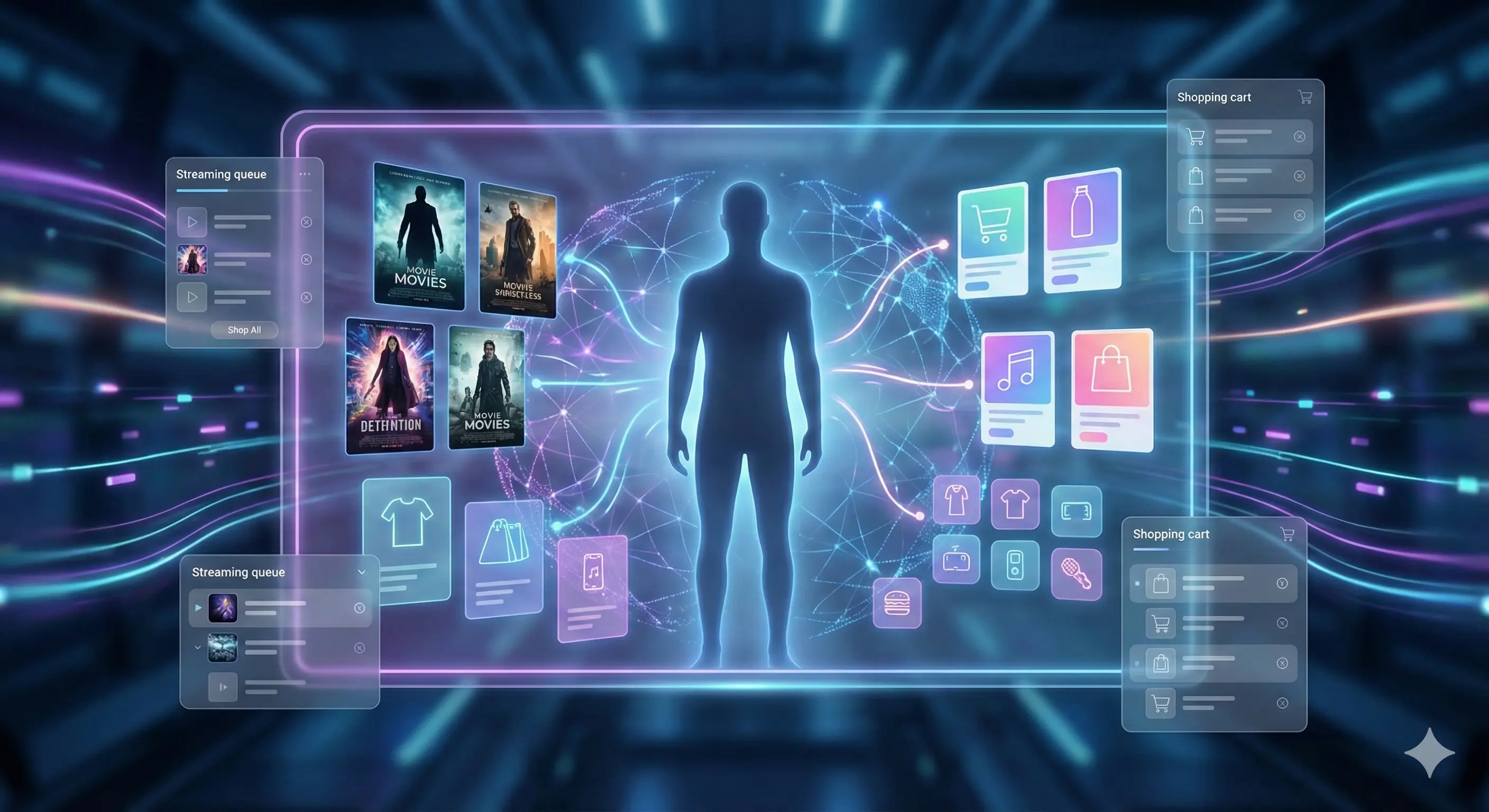
In the analog world, choice was limited. You watched what was on TV and bought what was in the store. The digital age flipped this dynamic. Suddenly, we moved from an economy of scarcity to an economy of infinite abundance. Netflix hosts thousands of titles; Amazon lists millions of products. This explosion of choice created a new problem: Information Overload.
When you can watch anything, you often end up watching nothing, paralyzed by options.
Enter the Recommendation System. These are the unseen engines of the modern internet, curators that cut through the noise to connect users with content they actually care about. They are why you "accidentally" binge-watch a new series or buy a gadget you didn't know existed. This guide dives into the mathematics of taste, the strategies of industry titans, and how machines predict human behavior.
The Core Philosophy
At a fundamental level, a recommendation system is an Information Filtering System. Its job is to predict the "rating" a user would give to an item they haven't seen yet.
To do this, engines rely on two types of data:
- Explicit Feedback: Data you knowingly give, like 5-star ratings or "likes." This data is high-quality but rare; most people consume content without rating it.
- Implicit Feedback: This is the bread and butter of modern algorithms. It tracks behavior: purchase history, clicks, and crucially, dwell time. Implicit data is "noisy"—clicking a link doesn't always mean you liked it—but it is abundant.
The engine’s goal is to take this messy data and answer a simple question: Given User A’s history, what is the probability they will engage with Item B?
The Three Main Algorithms
While tech stacks vary, almost all systems rely on three foundational algorithmic families.
1. Collaborative Filtering (The "Wisdom of the Crowd")
Collaborative Filtering (CF) is built on a sociological premise: Users who agreed in the past will likely agree in the future. It doesn't analyze the content itself; it only looks at the mathematical relationship between users.
-
User-Based Filtering: Imagine User A and User B both liked The Office. User B also watched Brooklyn Nine-Nine and loved it. The system infers that User A and User B have similar taste ("neighbors") and recommends Brooklyn Nine-Nine to User A. The logic is: "People like you liked this."
-
Item-Based Filtering: Instead of finding similar users, this finds similar items based on user interaction. If 90% of people who bought a Blender also bought Protein Powder, the system creates a link between those items. The logic is: "People who bought this also bought that."
The Flaw: CF suffers from the "Cold Start Problem." If a new movie is released today, nobody has rated it yet. Without interaction data, the model cannot recommend it.
2. Content-Based Filtering (The "Metadata" Approach)
This method solves the Cold Start problem by analyzing the item itself (metadata, tags, genres, keywords).
If you watch a movie tagged Sci-Fi and Space Travel, the system builds a profile for you that weights these tags heavily. It can then recommend a brand-new Sci-Fi movie immediately based on its description, even if no one else has watched it.
The Flaw: It creates a "Filter Bubble." The system is terrible at serendipity. If you only watch Action movies, it will never introduce you to a great Documentary because the metadata doesn't match.
3. Hybrid Systems (The Modern Standard)
To get the best of both worlds, giants like Netflix and Amazon use Hybrid Systems. They use Content-Based filtering to recommend new items (fixing the Cold Start) and Collaborative Filtering to capture the nuance of user taste. They often employ Matrix Factorization, a mathematical technique that decomposes user-item relationships into "latent factors"—hidden patterns that represent abstract concepts like "seriousness" or "quirkiness."
Case Study – Netflix (Optimization for Retention)
Netflix is arguably the most sophisticated user of these systems. Their business model depends on Retention. They don't make money per view; they make money if you don't cancel. Thus, their algorithm is designed to ensure you never run out of things to watch.
The "Taste Communities"
Netflix divides its 200+ million users into thousands of "taste communities." You aren't just a "Comedy fan"; you might be in a micro-cluster of "Users who like dark British crime dramas with strong female leads."
Contextual Artwork
One of Netflix's most innovative features is Artwork Personalization. Most platforms show the same thumbnail for a movie to everyone. Netflix generates multiple thumbnails for every title and uses AI to decide which one you are most likely to click.
Consider the movie Good Will Hunting:
- If you watch Romance, Netflix shows a thumbnail of Matt Damon and Minnie Driver kissing.
- If you watch Comedy, they show Robin Williams laughing.
- If you watch Blockbusters, they show a close-up of a recognizable star.
The movie is the same, but the sales pitch is personalized to your psychology.
Case Study – Amazon (Optimization for Conversion)
Amazon’s goal is different. They care about Conversion. They want to reduce the friction between "I want this" and "Purchase Complete."
Item-to-Item Filtering
In the early 2000s, Amazon realized User-Based filtering wouldn't scale. Comparing millions of customers to millions of other customers required too much computing power.
They shifted to Item-to-Item Collaborative Filtering. While people are unpredictable, items are stable. The statistical correlation between a Flashlight and Batteries doesn't change much. By pre-calculating these relationships offline, Amazon can serve recommendations in milliseconds.
The "Bundling" Effect
Amazon masters the "Upsell" using Association Rule Mining—the math behind "Frequently Bought Together." If the algorithm detects that Item A (camera) and Item B (memory card) are purchased together 40% of the time, it aggressively pushes Item B whenever Item A is in the cart. This increases the Average Order Value (AOV), a key metric for profitability.
The Future of Recommendations
Despite their success, these systems face challenges. The biggest is the Echo Chamber. Because algorithms maximize engagement, they often feed users more of what they already like. In entertainment, this is harmless; in news, it can lead to polarization.
The future lies in Context-Aware Computing. The next generation of engines will understand not just who you are, but where you are.
- Spotify is experimenting with this, using phone sensors to detect if you are running or sleeping, adjusting the playlist tempo accordingly.
- Travel Apps will soon recommend restaurants based not just on food quality, but on current weather and your fatigue level.
Conclusion
Recommendation systems have fundamentally reshaped the internet, acting as our personal digital concierges. From the sophisticated matrix factorization of Netflix to the high-speed item correlation of Amazon, these algorithms blend advanced mathematics with behavioral psychology.
As we move forward, the challenge shifts from "predicting what I like" to "predicting what is good for me." But for now, whether you are looking for your next favorite book or a new pair of headphones, you can be sure an algorithm is working silently in the background, ready to say: "If you liked that, you're going to love this."