

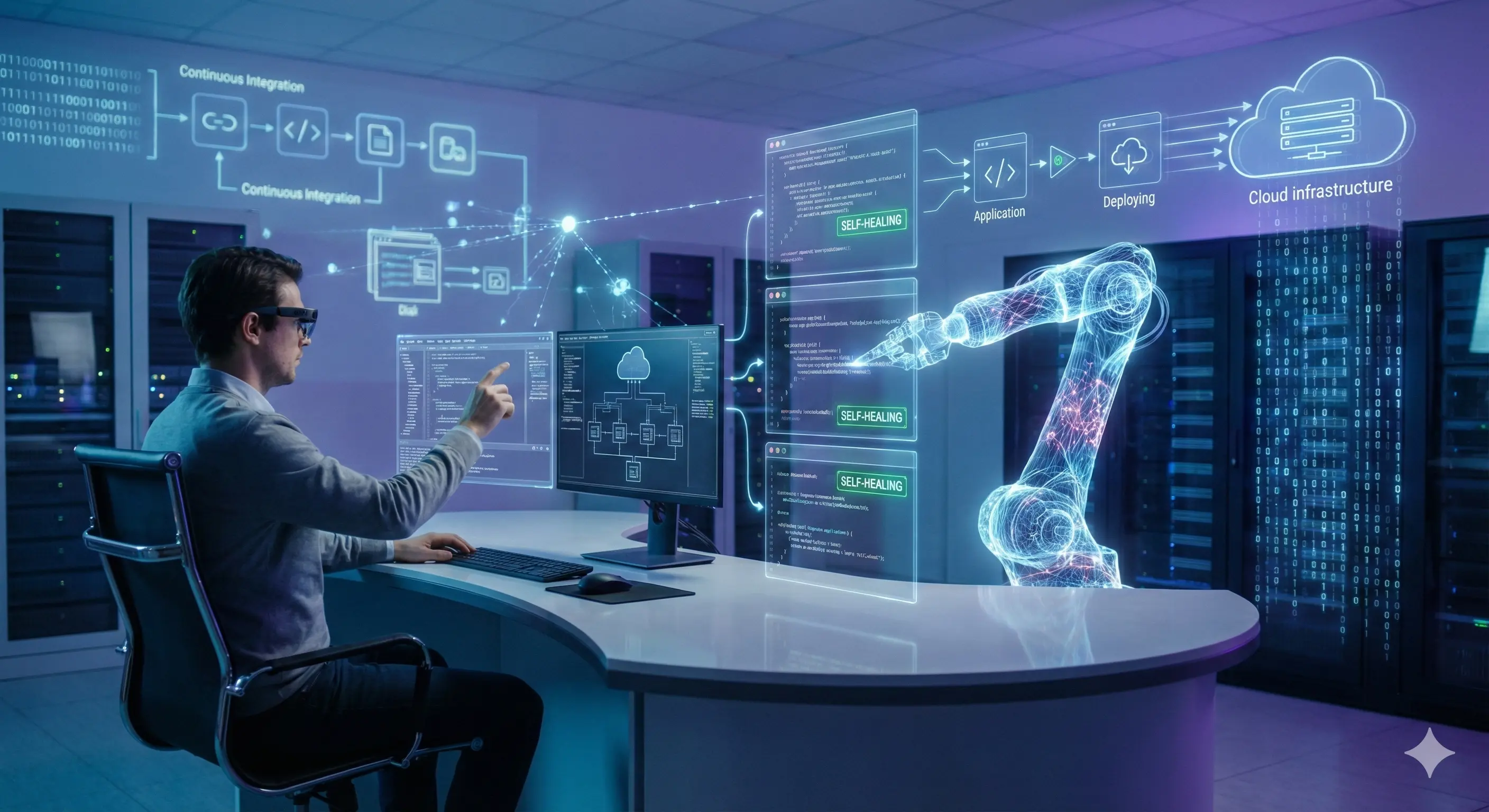
The software development industry is presently experiencing a paradigm shift from manual, script-based software development processes to a new era of "AutoDevOps" and AI-driven intelligence (Alenezi & Akour, 2025; Sengul et al., 2024).
As of 2026, automation is no longer a nicety for large corporations but a necessity to sustain release velocity and software quality. This new shift is changing everything from the way software code is developed to the way it is maintained and protected.
The Evolution of Automation: From Scripts to Intelligence
Automation was previously limited to static rule-based scripting for automating repetitive tasks like unit tests and simple build triggers (Alenezi & Akour (2025). However, today's automation technologies utilize machine learning and natural language processing technologies for developing "self-healing" and "context-aware" systems (Alenezi & Akour, 2025; Sengul et al., 2024).
These systems do not only execute commands but learn from previous changes and executions of the code, as well as user behaviors, and use this information to improve themselves (Sengul et al., 2024). The change is most pronounced in the move from traditional DevOps to AutoDevOps, where AI controls the entire Software Development Life Cycle, including planning, requirement analysis, and smart rollbacks (Sengul et al., 2024).
Key Tools Shaping the Landscape
The new toolset for a modern-day developer is no longer limited to simple IDEs and has grown to incorporate sophisticated AI-based code collaborators and autonomous testing platforms.
- AI Code Assistants: GitHub Copilot, Tabnine, and ChatGPT have emerged as critical components for developers to generate code autonomously and debug code with AI support and generate code documents (Alenezi & Akour, 2025; Sengul et al., 2024).
- Intelligent Testing Suites: New-age testing platforms like Testsigma, Tricentis Tosca, and Mabl incorporate AI for "self-healing" test automation. In a situation where a UI element changes its ID for some reason, these platforms can identify the UI element by its visual context or text content and avoid test failures that might be encountered with older testing platforms (Sengul et al., 2024).
- AIOps and Monitoring: Azure DevOps and Appsurify TestBrain utilize ML-based anomaly detection for identifying failing tests and resource bottlenecks before they even reach production (Sengul et al., 2024).
Emerging Trends for 2026
- Automated Context Discovery: As the complexity of projects increases, it becomes hard to provide the appropriate context to AI. Current frameworks enable the automatic creation of "Project Indexes" and "Tables of Contents" to assist AI in understanding complex architectural patterns without human intervention.
- Predictive Maintenance: Automation is shifting from reactive to proactive. AI models are now capable of analyzing operational data to predict possible API failures or bottlenecks before they happen (Alenezi & Akour, 2025; Sengul et al., 2024).
- Secure Software Development Frameworks (SSDF): As the number of automated vulnerabilities increases, the practice of DevSecOps at the architectural level is now common, aiming to minimize the "attack surface" during the coding process (Souppaya et al., 2022).
Best Practices for Successful Implementation
To reap the full benefits of automation without succumbing to the pitfall of overdependence on it, organizations can follow these strategic guidelines:
- Maintain Human Oversight: Although AI can create codes on its own, human expertise cannot be replaced in matters of critical architectural decisions (Alenezi & Akour, 2025; Sengul et al., 2024).
- Implement Gradual Integration: This can be achieved by initially automating specific processes like unit tests or documentation before moving on to AutoDevOps (Alenezi & Akour, 2025).
- Focus on AI Literacy: With the evolution of new coding jobs, developers need to be proficient in handling AI tools. This includes understanding the logic behind AI tools’ generated suggestions in order to avoid "superficial" programming (Alenezi & Akour, 2025; Zviel-Girshin, 2024).
- Prioritize Explainability: Organizations should choose tools that provide transparency in their decision-making process. "Black box" automation can result in "difficult to debug" errors (Alenezi & Akour, 2025; Sengul et al., 2024).
Conclusion
The advent of automation represents a paradigm shift in software engineering. By embracing these technologies and trends and keeping one’s feet on the ground of best practices, one can achieve unprecedented levels of productivity and reliability. The future belongs to those who can successfully integrate human creativity and machine intelligence.
References
- Alenezi, M., & Akour, M. (2025). AI-Driven Innovations in Software Engineering: A Review of Current Practices and Future Directions. Applied Sciences (Switzerland), 15(3).
- Sengul, C., Neykova, R., & Destefanis, G. (2024). Software engineering education in the era of conversational AI: current trends and future directions. In Frontiers in Artificial Intelligence (Vol. 7). Frontiers Media SA.
- Souppaya, M., Scarfone, K., & Dodson, D. (2022). Secure Software Development Framework (SSDF) version 1.1.
- Zviel-Girshin, R. (2024). The Good and Bad of AI Tools in Novice Programming Education. Education Sciences, 14(10).